Hurricane Lala brought destruction to Hawaii, and in its wake, it left downed trees, along with landslides and mudslides that left towns and villages buried. Recovery efforts from Hurricane Lala are well underway, but the next tropical storm is already on the horizon.
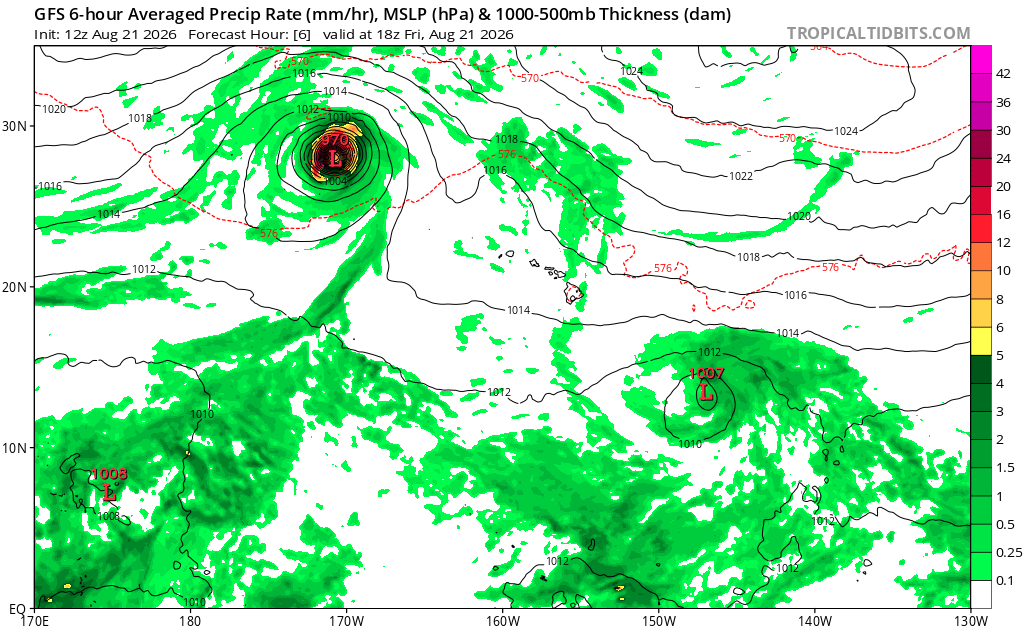
After Lala brushed past southern Hawaii last weekend, the next storm has already set its sights in the islands, though this time more southern. Image provided by Tropical Tidbits
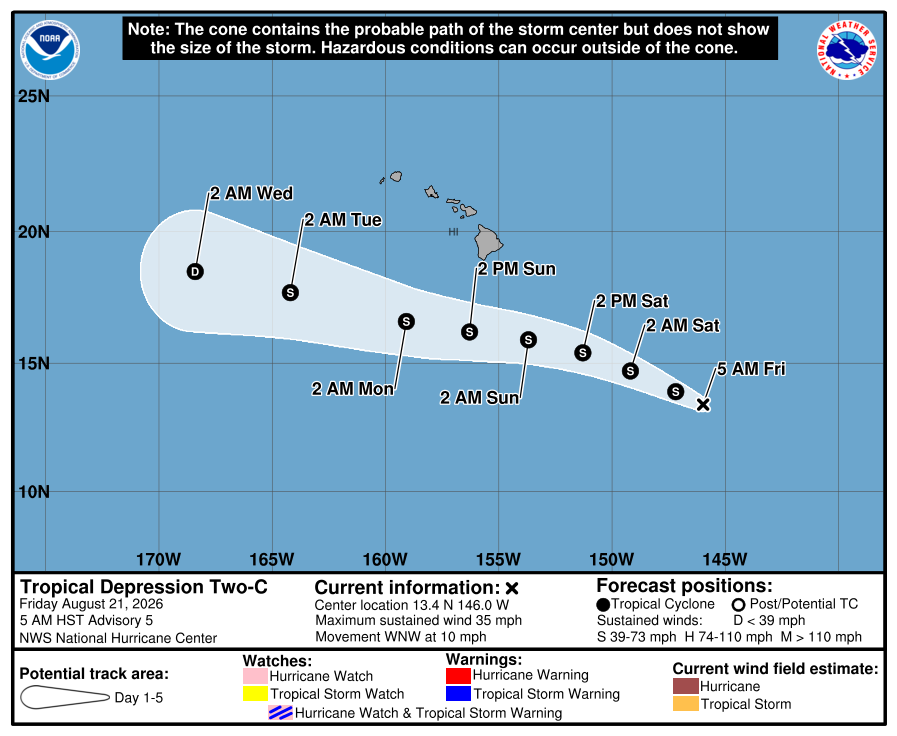
The storm, currently Tropical Depression TWO-C, is forecasted to remain relatively weak while staying south of the islands through the weekend, though that doesn’t mean that it won’t have significant impacts. After Lala, Hawaii’s soils are thoroughly saturated, and another significant storm could cause flooding and land or mudslides that will make current recovery efforts even more difficult. While Hawaii is no stranger to tropical impacts, having 2 potentially named systems back to back is unusual.
Tropical Depression TWO-C is looking to make a close pass south of Hawaii through the weekend of the 22nd of August 2026, just a week after Hurricane Lala impacted the islands. Image provided by NOAA
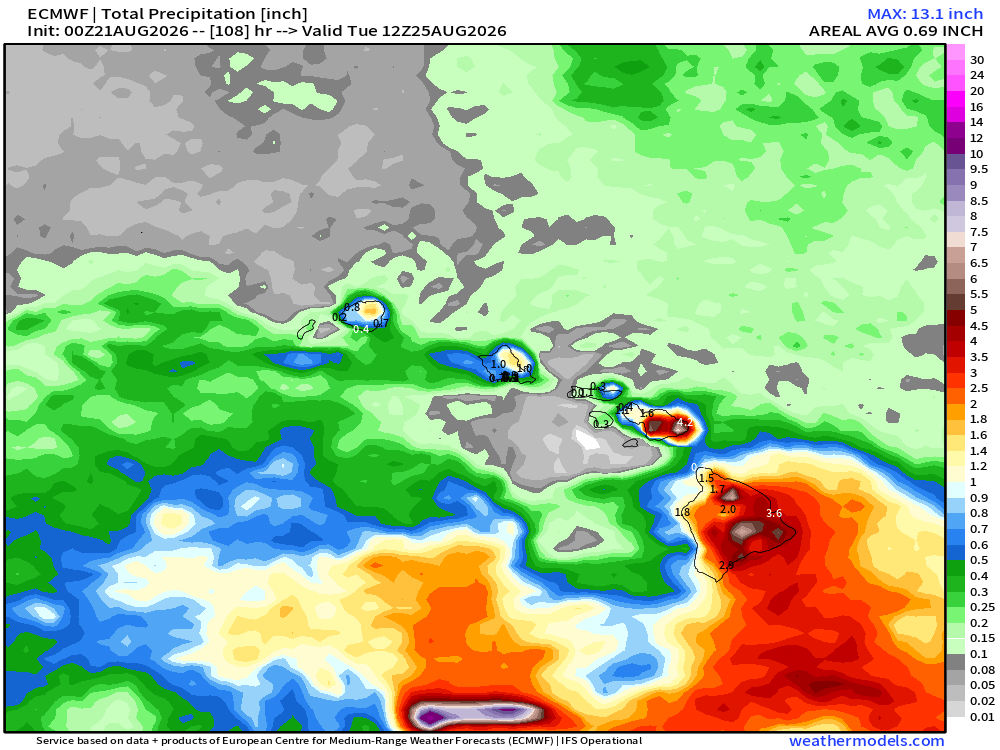
Though the system is expected to stay to the south, Hawaii’s Big Island could see up to a foot of rain as the storm approaches, especially on the windward side of the island where slopes are steeper. Rainfall from Lala has already made these slopes unstable, and more rainfall could destabilize them, causing more mudslides or landslides and making recovery after Lala more difficult.
Hawaii’s Big Island could see 12 inches of rain, with isolated areas of greater than that through the weekend. Image provided by Weathermodels.com
With TWO C being forecasted on the weaker side, its path and impact could change significantly as the weekend progresses. Current conditions and forecasts indicate that it could still die out before reaching the Islands, but until that happens, it is safe to assume impact will occur.
A persistent upper level high will keep the west sweltering this weekend, while the south-central and eastern US sees cooler temps and scattered showers.
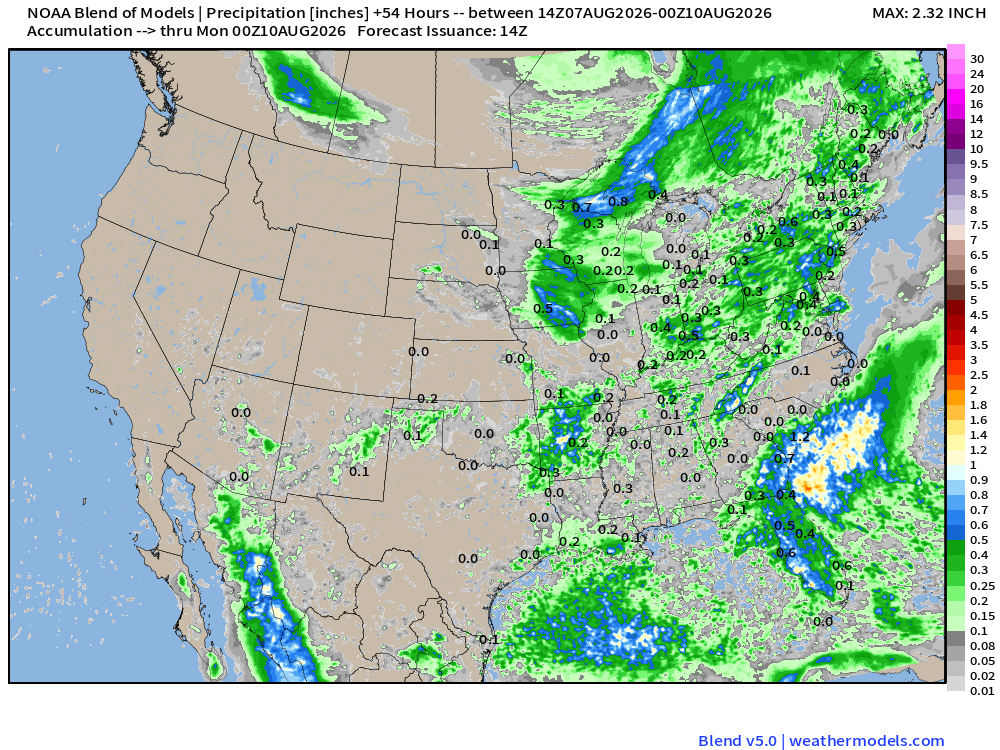
Rainfall across the eastern US will remain on the lower end for most regions. A convective system will be moving in off the Atlantic, potentially bringing totals of an inch or greater, but for the most part will remain at sea. Image provided by Weathermodels.com
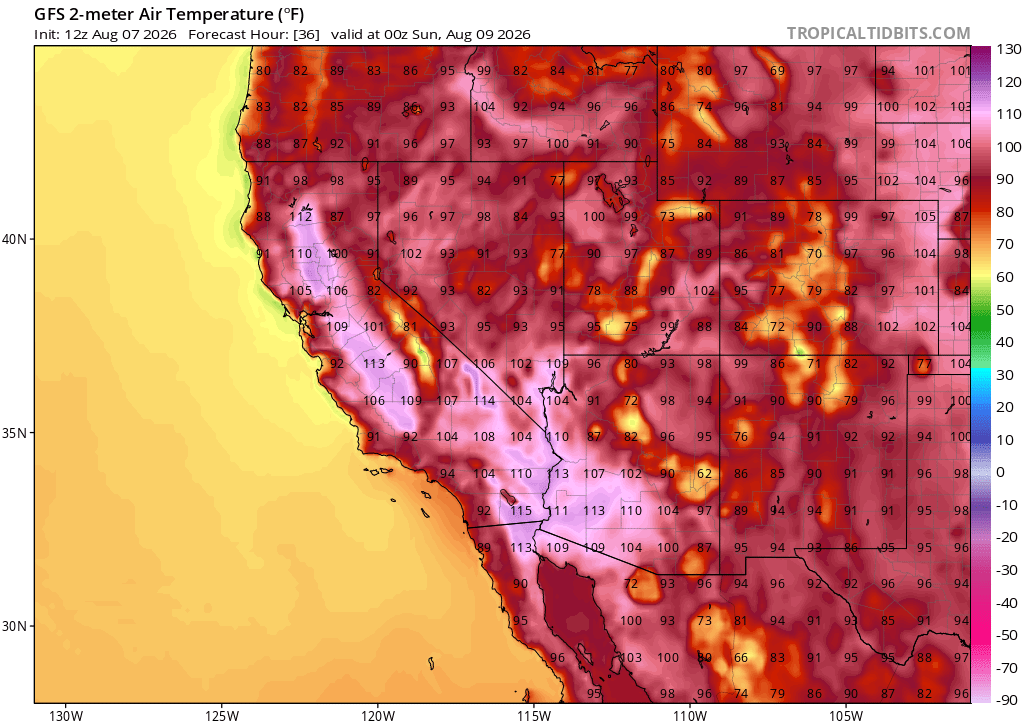
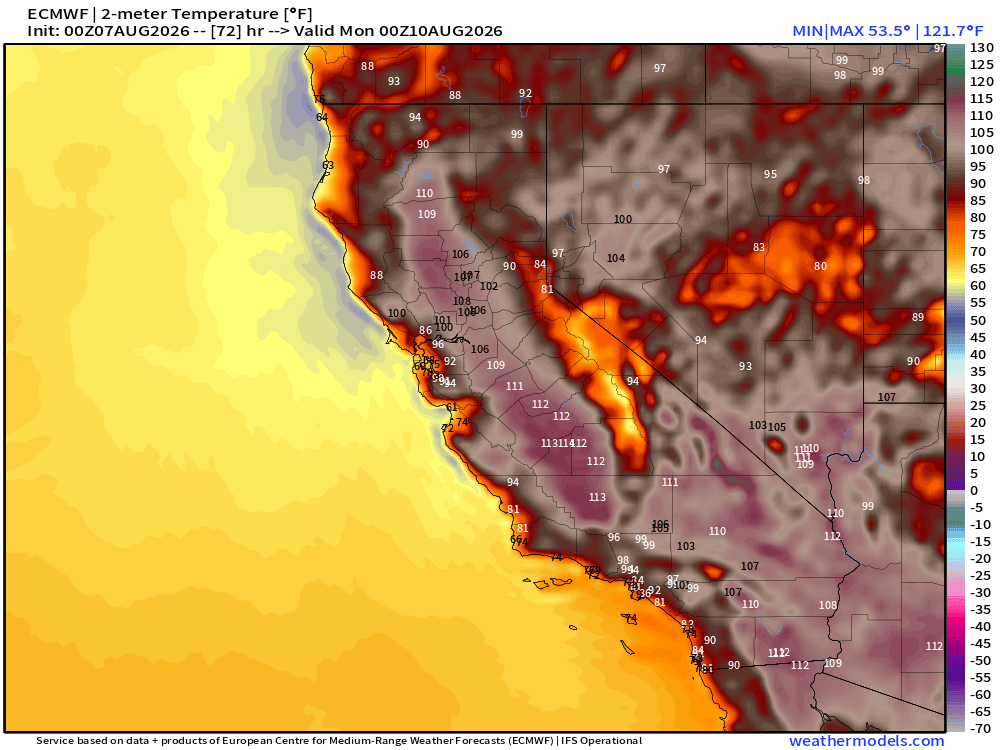
Starting on Saturday, extreme heat warnings and heat advisories will persist through much of the Western US as an upper level high pressure persists. Heat indices will be in the 90s and 100s across the southwestern US and the Central Valley in California, with temperatures in the 100s and 110s, with the Mojave Desert potentially reaching the 120s. Overnight lows will be in the 60s and 70s in Central and Northern California, while only reaching the 80s in Southern California, providing little relief. Northern coastal cities won’t get as hot, looking to only reach the upper 60s during the day, and lower 50s overnight, though offshore winds will keep the relative humidity in the upper 60s and 70%. As with any extreme heat, limit outdoor activity when possible, and drink lots of fluids to keep hydrated.
Satuday high temperatures in the southwest will be in the 90s and 100s, with lows could only reach the 80s in some areas. Image provided by Tropical Tidbits.
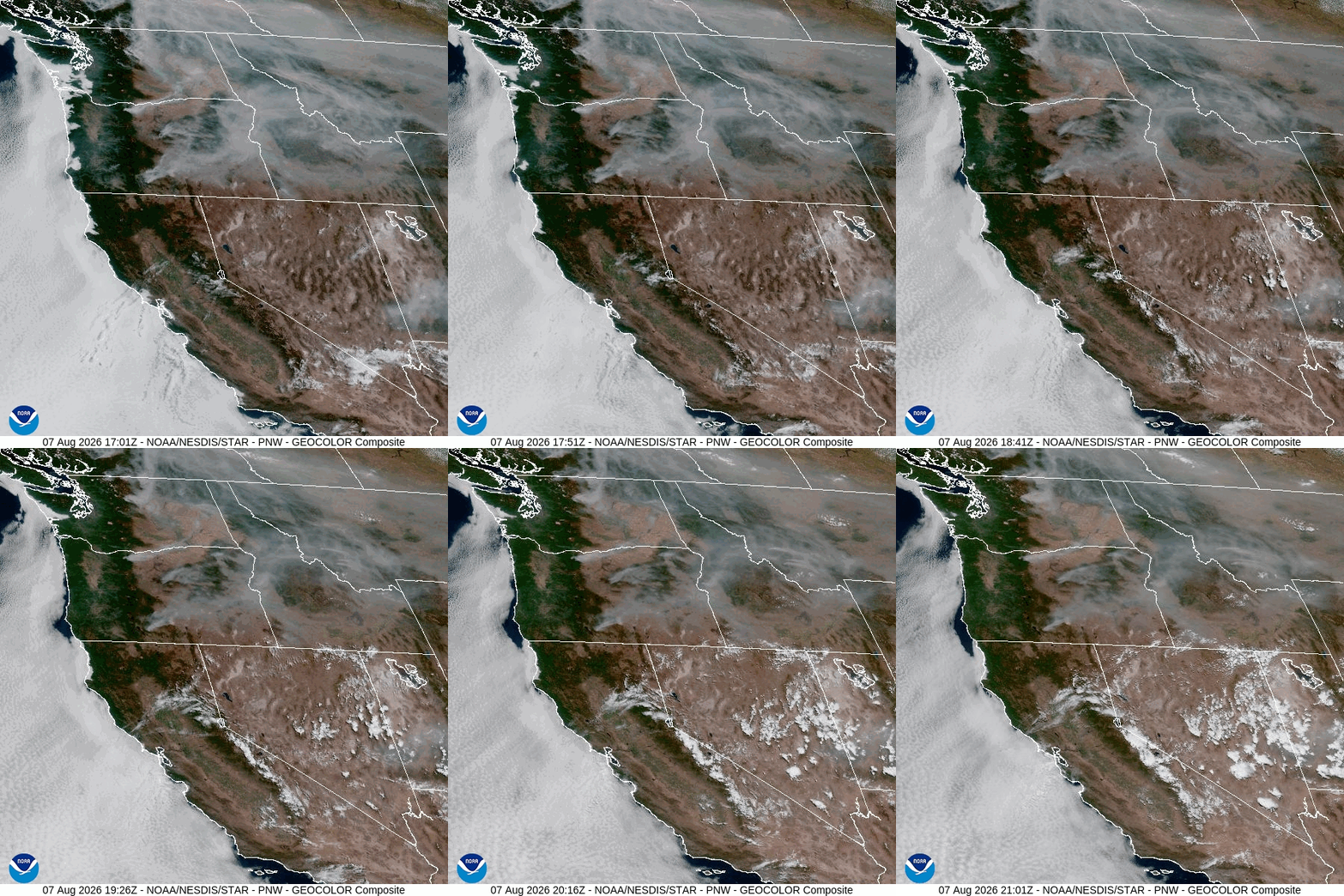
The main hazard in the northwest will be air quality and fire weather through Saturday. With fires already active and very little air movement in the region, smoke can build up to unsafe levels for most people. Additionally, dry conditions inland combined with temperatures in the 80s and 90s will allow for even the smallest fire to quickly expand.
Wildfire smoke across the Pacific Northwest. Loop provided by NOAA
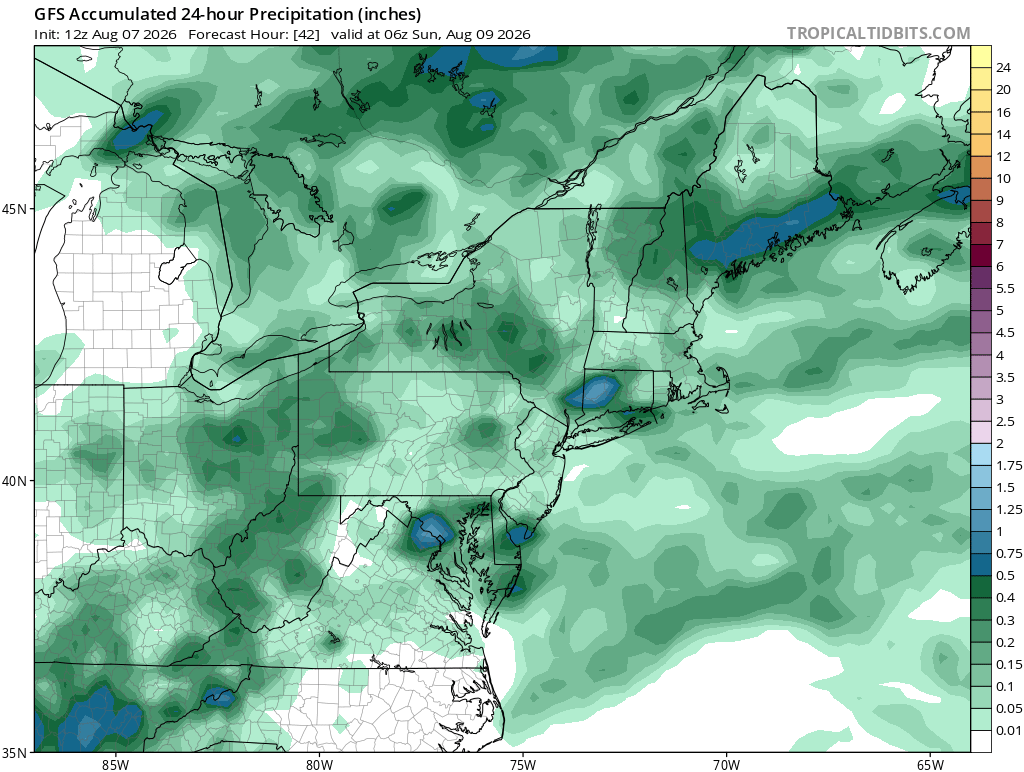
The central US will also experience highs in the 90s and 100s, though no heat advisories have been issued. Dew points will generally be in the 40s to 60s, creating dry conditions, and as such no rain is expected for much of the north-central US. New Mexico and the Texas panhandle could see a light shower or two, but accumulation should remain below half an inch. The Ohio Valley through to the Northeast could see scattered showers, though totals shouldn’t be more than half an inch. Highs in the Northeast and Mid-Atlantic will be around the 80s and 90s.
Rainfall across the Northeast should remain below half an inch for much of the region. Image provided by Tropical Tidbits
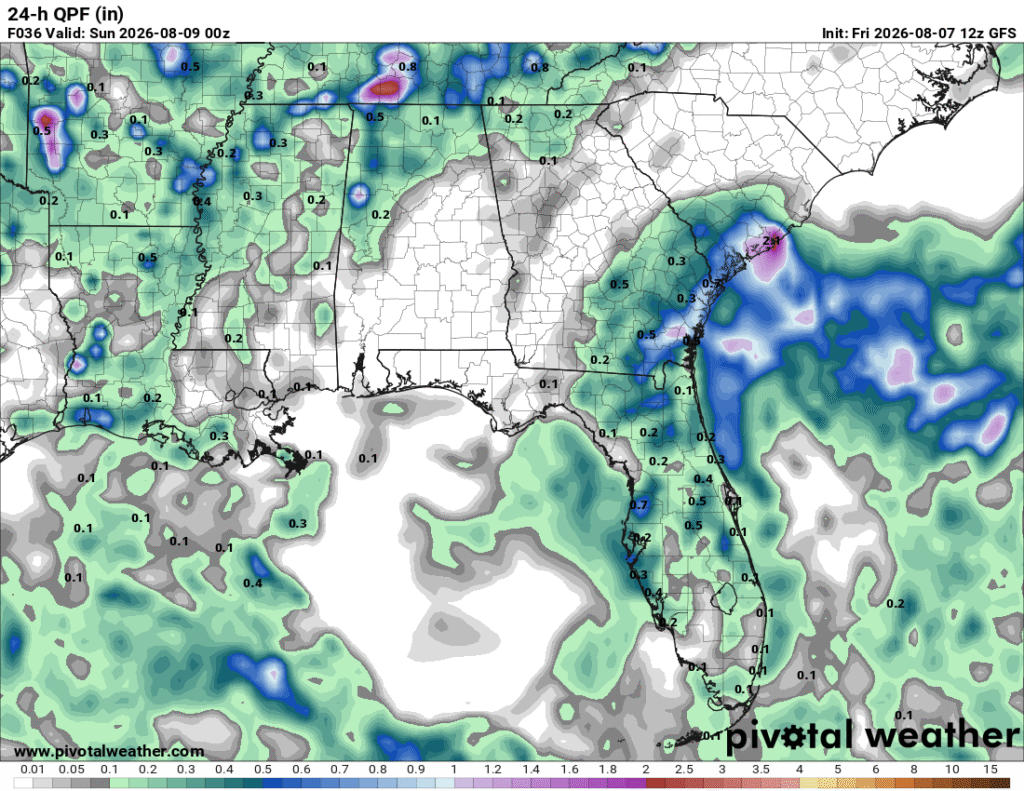
In the southeast, Highs will remain consistent in the 80s and 90s. As an offshore convective system makes its way towards the coast, Coastal Eastern Florida, Georgia, and South Carolina could see precipitation totals from isolated showers around .75 inches with localized totals of 1+ inches.
Coastal cities in the southwest could see isolated storms as a convective system moves close to shore, but most rainfall will remain in the Atlantic. Image provided by Pivotal Weather.
Sunday will see some relief from the heat in the Northwest as high temperatures dip into the 80s and 90s, and lows in the 50s and 60s. Air Quality advisories will persist through Sunday as surface winds remain low, while upper level winds carry lofted smoke downwind. Heat advisories and warnings will remain active in the southwest, with highs in the 90s and 100s, with the Mojave reaching 110+.
The Southwest will continue to swelter on Sunday as highs stay at or above triple digits inland. Image provided by weathermodels.com
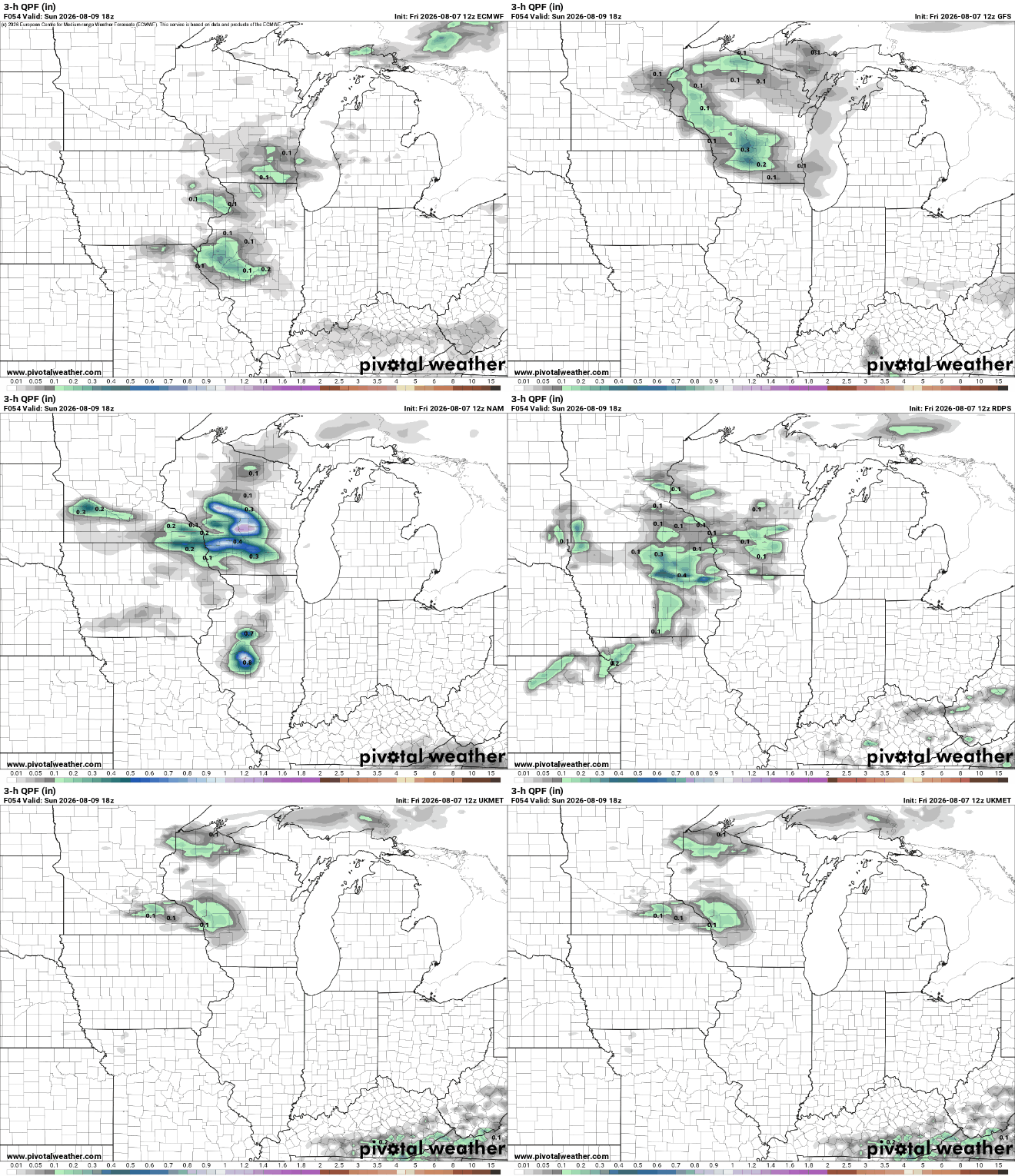
The Northern Central Plains could see some severe weather on Sunday as a system quickly moves through the central and northern plains into the southern Great Lakes. The primary risk will be localized heavy rain, with hail and wind also possible, though the precise timing and location of the system is still uncertain. Highs in this region should remain in the mid 70s to low 80s across the region. The Eastern US overall will see highs continue to be in the 80s and 90s. Scattered showers are possible in the southwest into the south-central, with accumulations of around a third of an inch, with localized higher amounts possible along the Gulf.
The precise timing and location of the system moving through the Central Plains and Southern Great Lakes is still uncertain. Loop provided by Pivotal Weather
Through the rest of the week, relief from the heat is in sight for the southwest as the upper-level ridge weakens, though the southwest will now be under its own, bringing highs into the 90s and 100s. The northern Great Plains and Northeast could get the first taste of fall as overnight lows drop into the 40s and 50s, though highs will remain in the 70s and 80s.
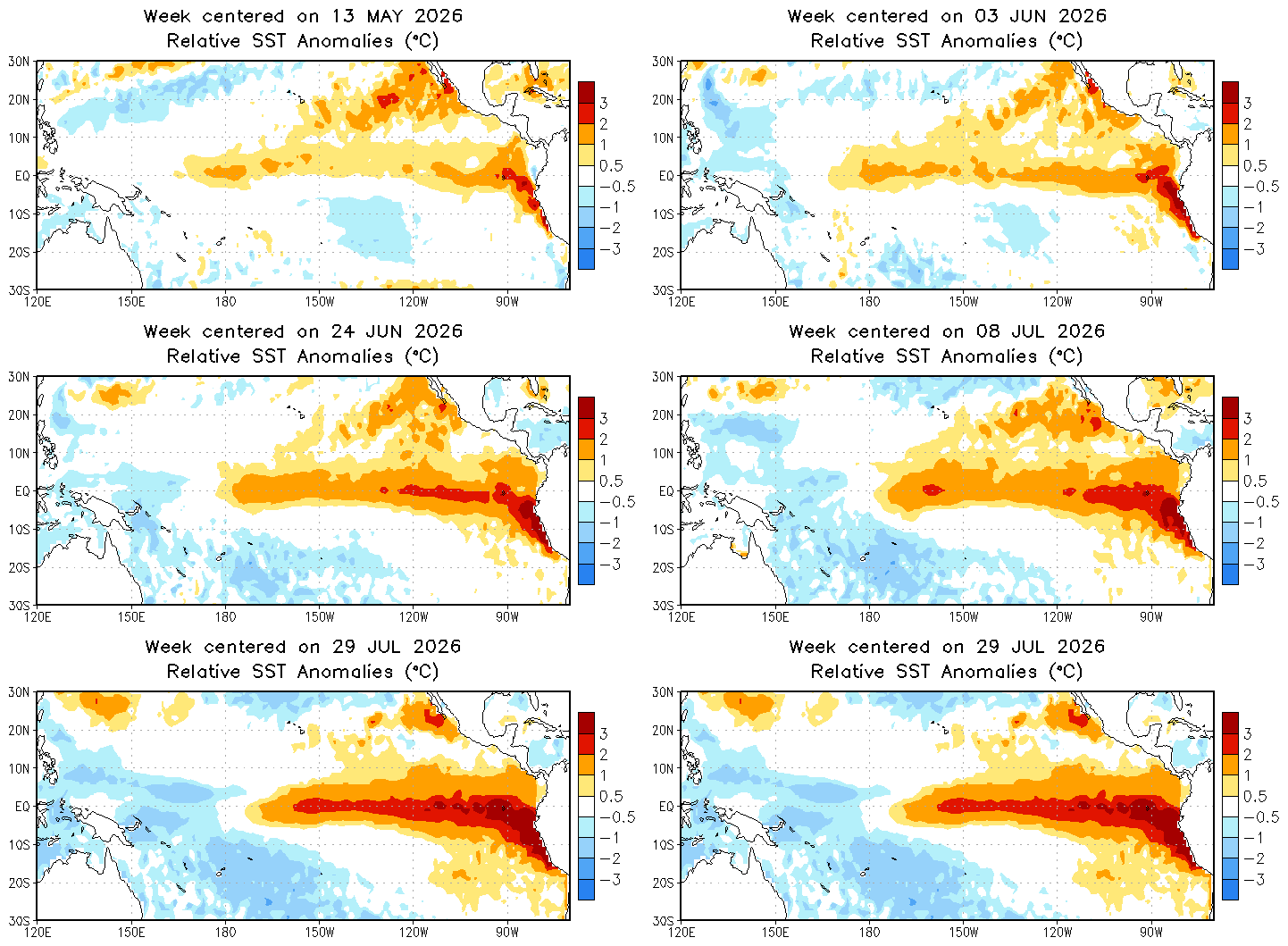
As the Atlantic hurricane season moves into its typical peak season from August to November, one key factor is preventing a prime region of formation from looking likely to see much development: a very strong El Niño that is expected to persist through early spring.
El Nino Sea Surface Temperature anomaly development from May to July 2026. Loop provided by NOAA/CPC
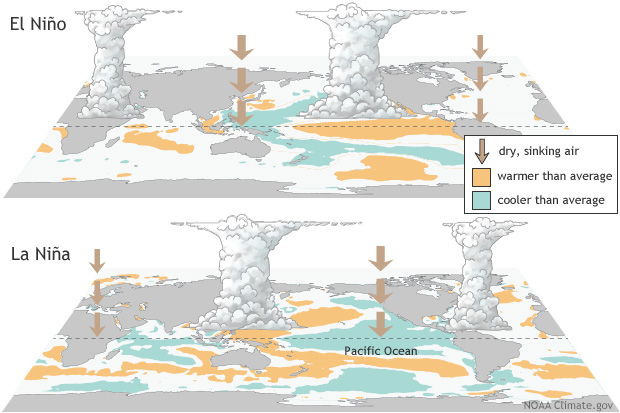
El Niño describes a warming of oceanic surface temperatures in the eastern Pacific along the equator. Typically detected as underwater movement below the ocean surface some time before it appears, it’s not officially declared until 3 months of warming have occurred, and it drastically changes how atmospheric currents behave. In El Niño, the primary upward motion in the Pacific occurs over the eastern Pacific, where El Niño is located. As a result, the primary downdraft occurs over the Eastern Atlantic Ocean.
El Nino air currents have rising motion over the Eastern Pacific and Sinking motion over the Atlantic, while La Nina is the opposite. Image provided by NOAA
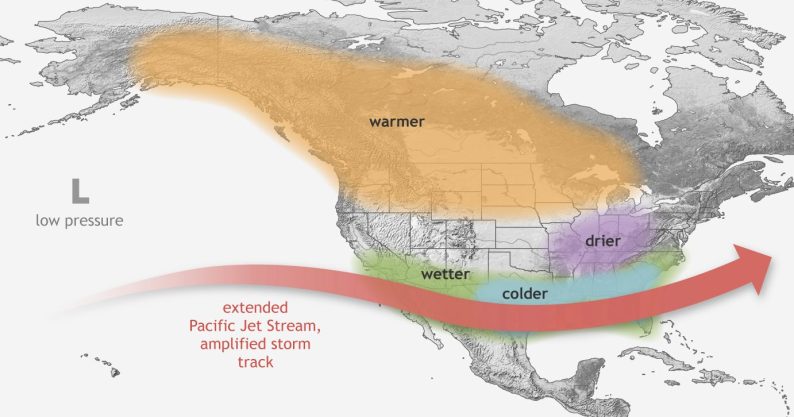
Additionally, El Niño strengthens the jet stream, keeping it southward and positioned over the Atlantic and the Gulf. As a result, wind shear over the Atlantic prevents most storm formation in the Gulf and the equatorial Atlantic, especially in later months.
El Nino strengthens the jet stream, keeping it southward over the atlantic and the gulf. Image provided by NOAA
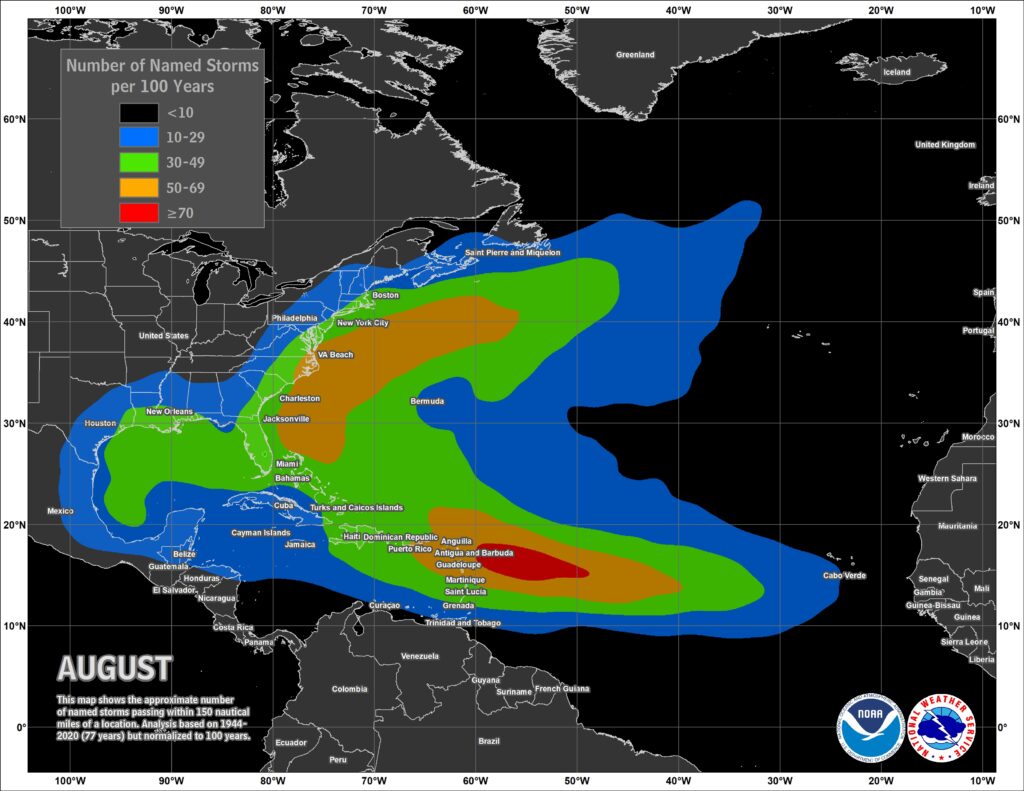
This combination of factors creates atmospheric conditions that are incredibly unfavorable for tropical storms to form in the Gulf and Atlantic, especially at this time of year, where the most favorable zone is normally just north of South America and just east of the Caribbean. However, storms can still form off the East Coast of the United States. When they do, they typically take one of two paths. Out to sea, or moving north along the coast. Storm systems may still try to appear in the Atlantic and the Gulf, though most of them end up torn apart by the shear forces or never develop rotation, preventing them from becoming nothing more than a cluster of thunderstorms over the open sea that could arrive at the coast.
The typical tropical storm formation distribution for the month of August. Image provided by NOAA.
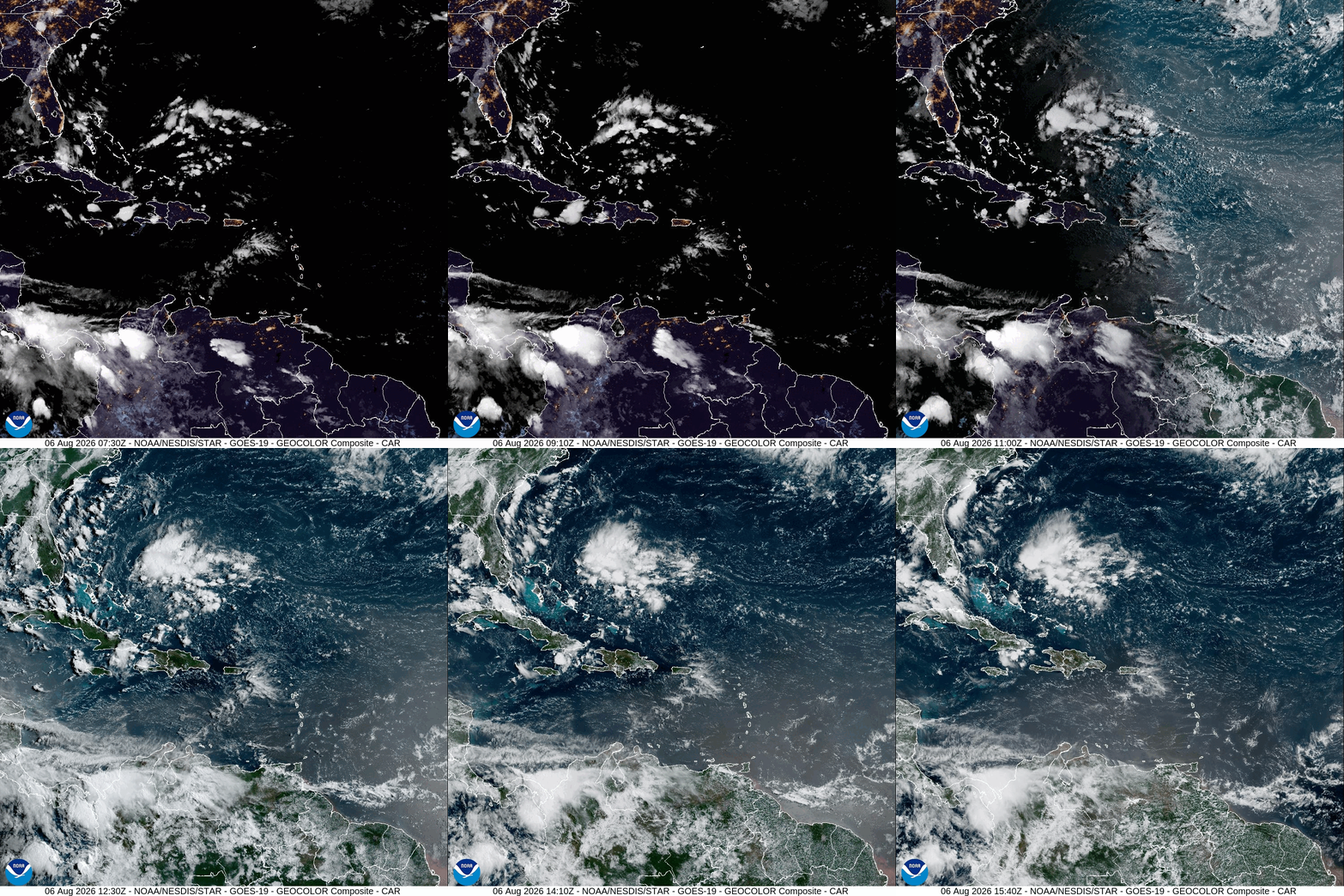
While wind shear may prevent major storm development, some systems do still break through. Systems such as these typically stay as clusters of thunderstorms rather than developing into tropical depressions or hurricanes. The real danger comes from storms that start to rotate, as these can develop into tropical storms or even hurricanes that then move along the coast or across Florida. One example of a hurricane that developed in this region before moving across Florida and into the Gulf is Hurricane Andrew in 1992. The season started slowly, as Andrew was not named until August 16, meandering in the central Atlantic before rapidly strengthening to Category 5 before making landfall.
Storm systems may still develop in the Atlantic, but none will get very strong as wind shear caps development. Loop provided by NOAA.
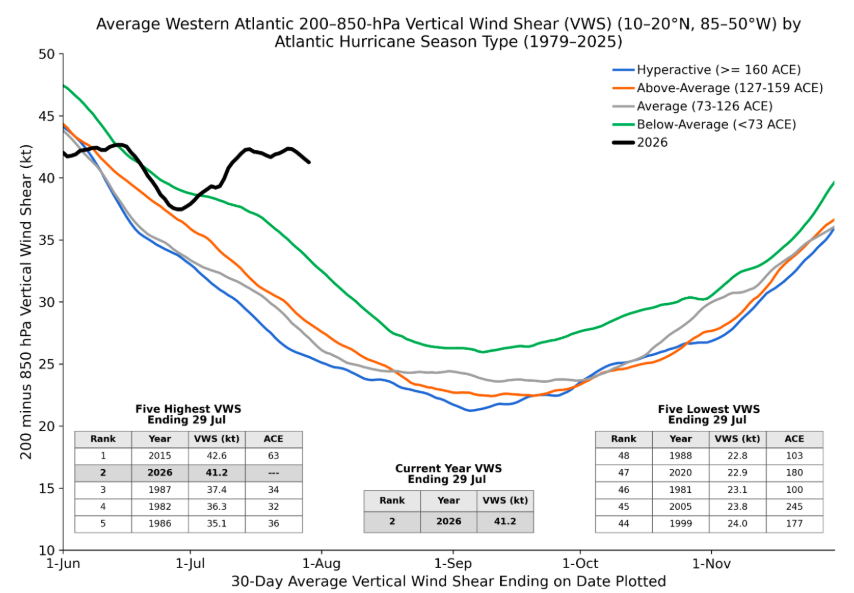
As for how much wind shear there is currently, and why there are no storm developments expected in the Atlantic anytime soon, wind shear values are similar to those of the 2015 season, with the current season currently running as the second strongest wind shear across the Atlantic.
Wind shear is well above normal for this time of year, attributed to the very strong El Niño in the Pacific. Image provided by Colorado State University Department of Atmospheric Science
While the Atlantic may be looking to remain calm for the foreseeable future, as proven many times over the years, it only takes one storm for it to become an impactful hurricane season.
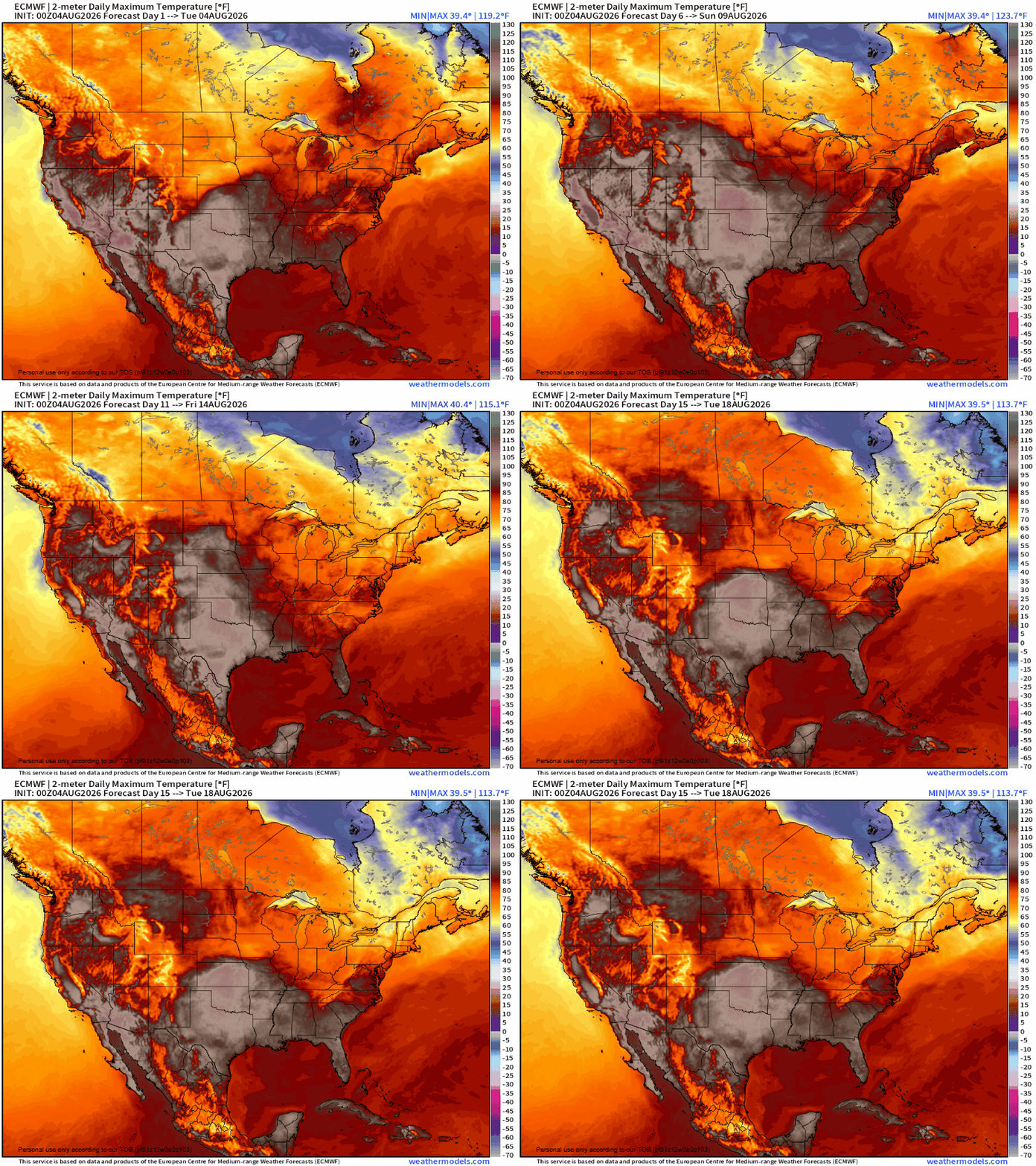
As August begins, a persistent upper level ridge is looking to settle over the Western US, bringing extreme heat and fires as the explosion of vegetation through the summer dries out.
Daily high temperatures in the south central and southwestern US will be in the high 90s and 100s, with 110+ possible. Loop provided by WeatherModels.com
Rainfall is always welcome in warm, arid climates, as it provides needed relief from the temperature and assists in refilling reservoirs that might be in need of water – especially after a drought – and promotes explosive vegetation growth, mostly of small grasses and wildflowers. Following a drought, this rainfall also brings hazards of its own. More well known hazards are flooding and land or mudslides, but that rapid vegetation growth can become a big risk depending on how conditions change in the following weeks.
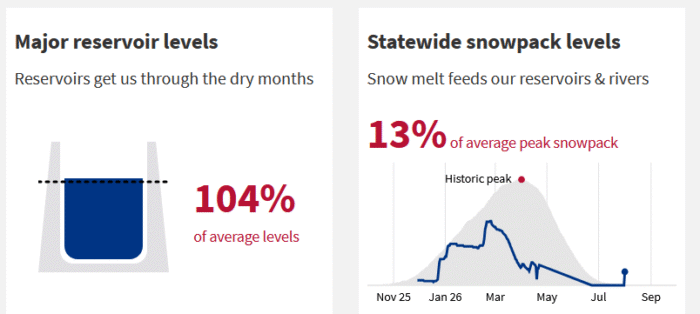
California’s major reservoirs are just above the average historic level. Considering that last year’s snowpack was one of the lowest on record, rainfall runoff into the reservoirs has done most of the fill. Image provided by the California Water Watch
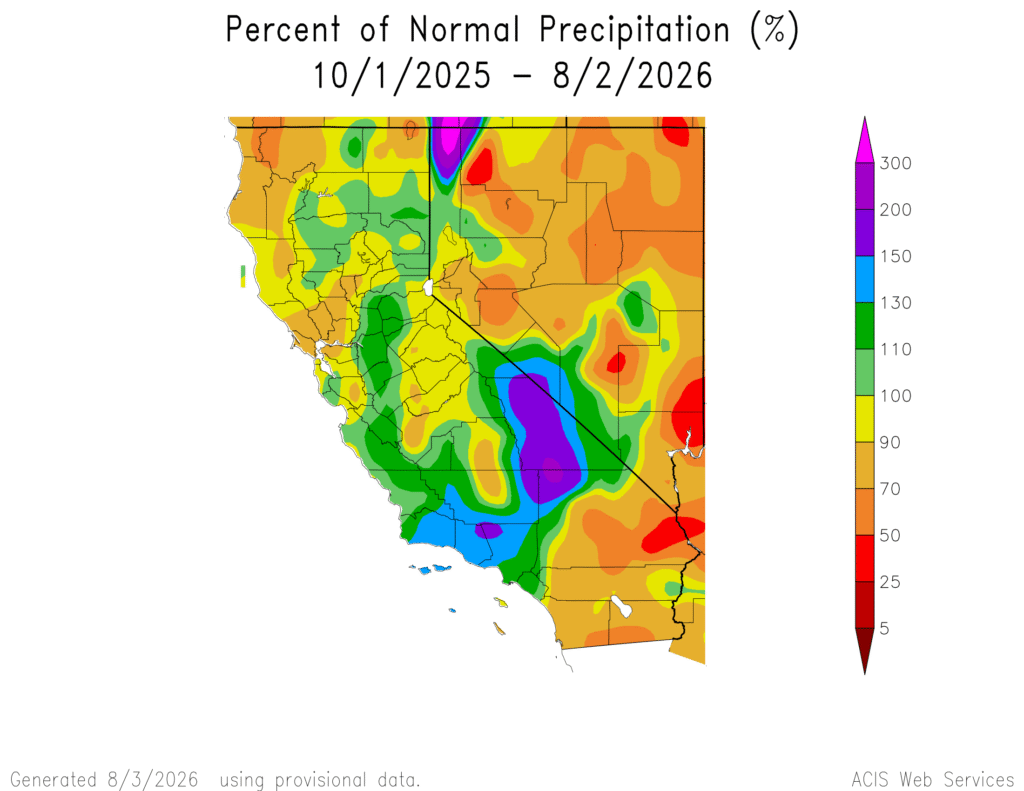
California (and other Western states) bases its precipitation on a slightly different scale than Eastern states, known as the Water Year, and it runs from October 1st to September 30th every year. This water year, totals across the state are just below to around normal in the northern regions of the state, while central and southern portions have been near to well above average. Given that this year had record low snowpack development, the above average rainfall has maintained reservoir levels at around normal across the state, and promoted the growth of vegetation.
Parts of California and the Southwest have seen near to above normal rainfall, with Southern California approaching 150 to 200% above normal. Image provided by the Placer County Water Agency
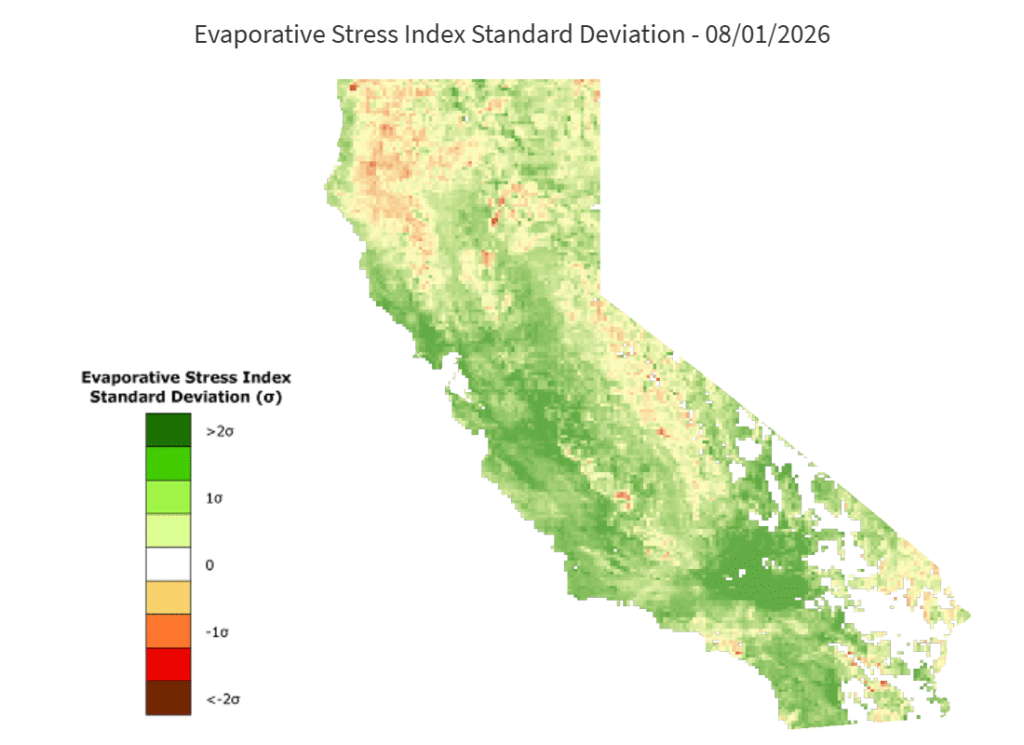
One location of note; Death Valley received 3.5 inches of rain this water year. This might not seem like much, but when you consider that the average yearly rainfall here is only 2.2 inches, that is 160% of the average rainfall, and it lead to a super-bloom of wildflowers. In fact, much of the area between the Mojave Desert and Los Angeles has reported above 120% of their yearly rainfall, causing impressive vegetation growth. Though this growth comes with a major risk as it dries out: Wildfires
Vegetation conditions are above normal across California. The Super Bloom that occurred in Death Valley early this summer is clearly visible. Image provided by the California Water Watch
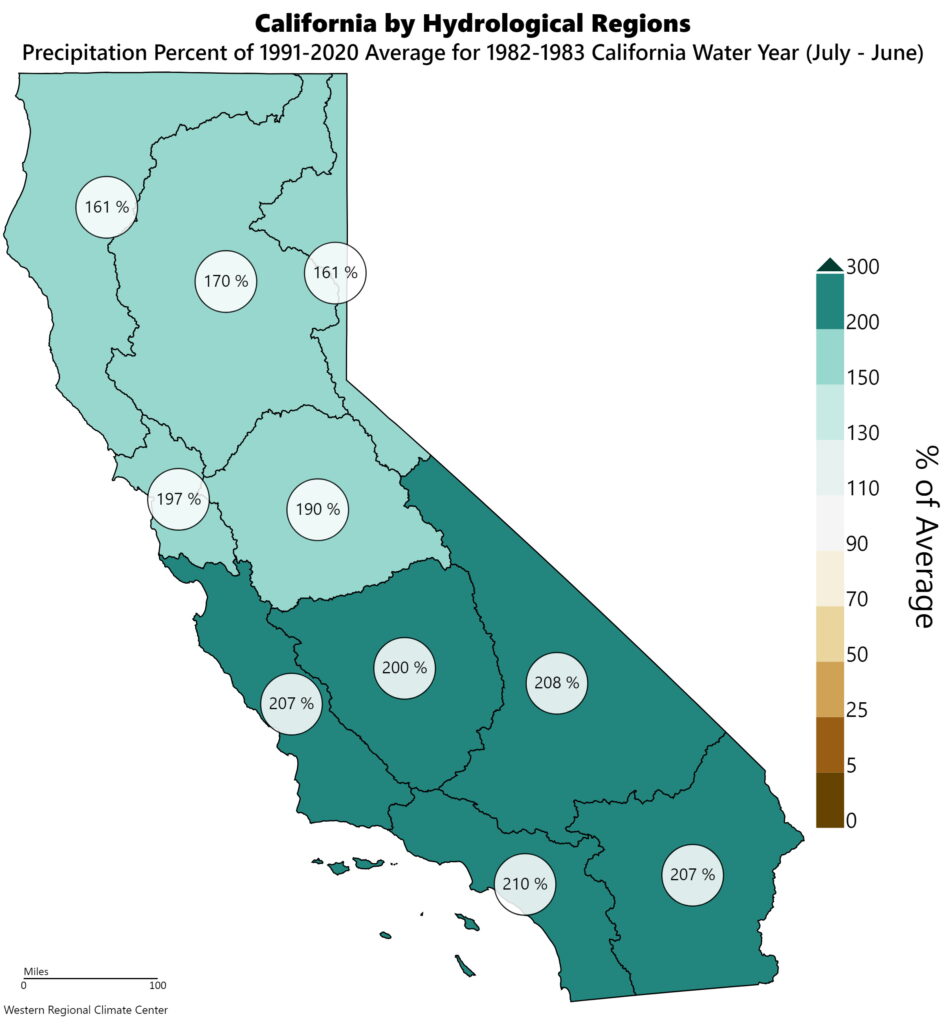
Southwest US and California droughts are very closely tied to the ENSO cycle. In El Nino years, Southern California across into Texas see well above average precipitation. As an example, the 1982-83 El Nino brought rainfall totals to California that were 150 to 200% above normal compared to the 1990 to 2020 normals. As El Nino changed to La Nina the following year, California experienced a drought that saw three hundred thousand acres of land burned.
Rainfall totals as a percentage of normal for the 1982 to 1983 El Nino. Image provided by Golden Gate Weather
As we head into a very strong El Nino in the 2026 through 2027 fall and winter, California is likely to see at or above normal precipitation. The South Central US is already well above normal, and this could continue through winter.
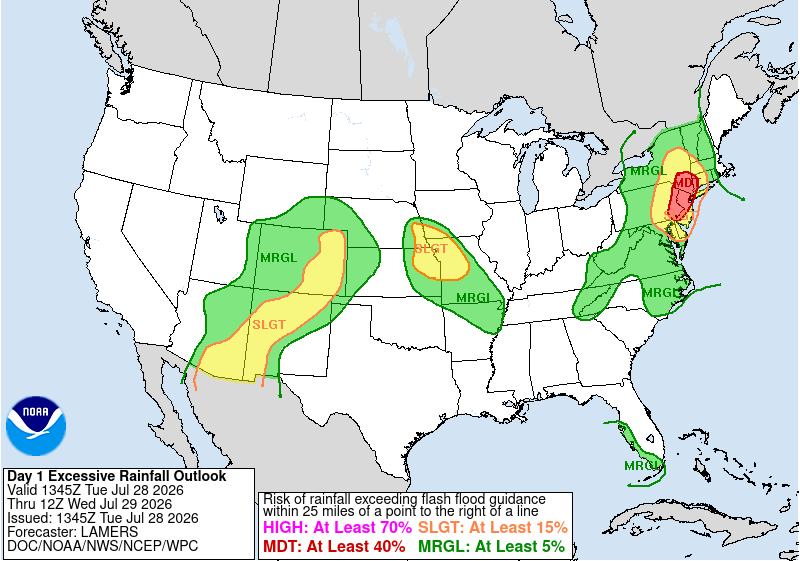
The weather pattern flips this week, bringing widespread rain and a high likelihood of flooding and flash flooding to the Northeast and Mid Atlantic.
Excessive Rainfall outlook for June 28th, with a noteable Moderate risk around New York City and New Jersey. Image provided by NOAA/WPC
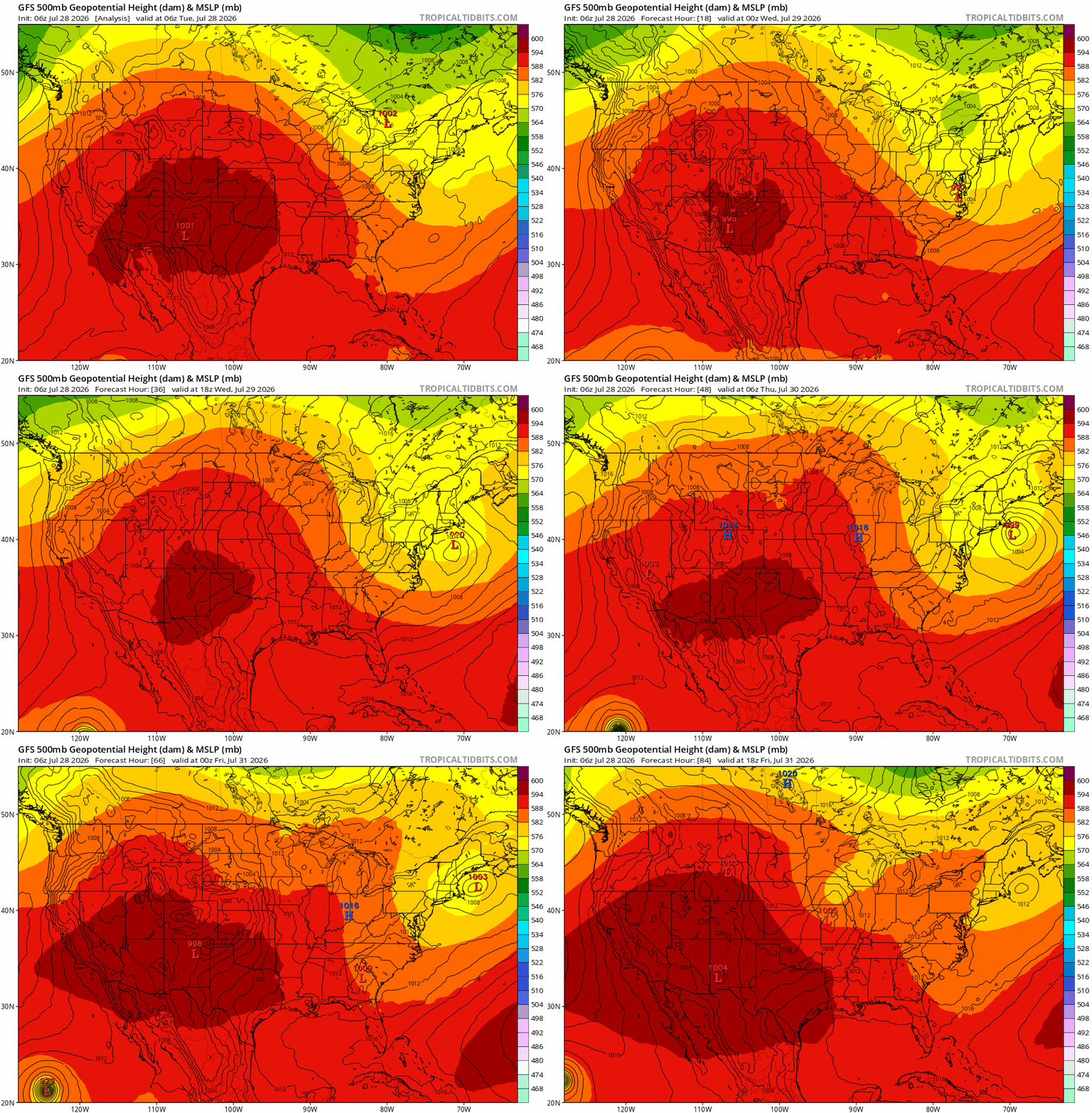
Through the 29th to the 31st of July, a strong surface low will move quickly over the northeast bringing signifigant rain across the region. On Tuesday the 28th, an upper level trough will redirect the surface low along its southern edge and off the coast as it develops into a strong cut off low – A low pressure system that is disconnected from the prevalent wind direction – that persists until Friday the 31st. While the system is moving from the west-northwest initially, the cut off low will redirect moisture from the great lakes to the southeast, before moving northward along the Atlantic coastline.
Northeast weather patterns setup for a widespread flooding event. The surface low stalls off of new england Loop provided by Tropical Tidbits.
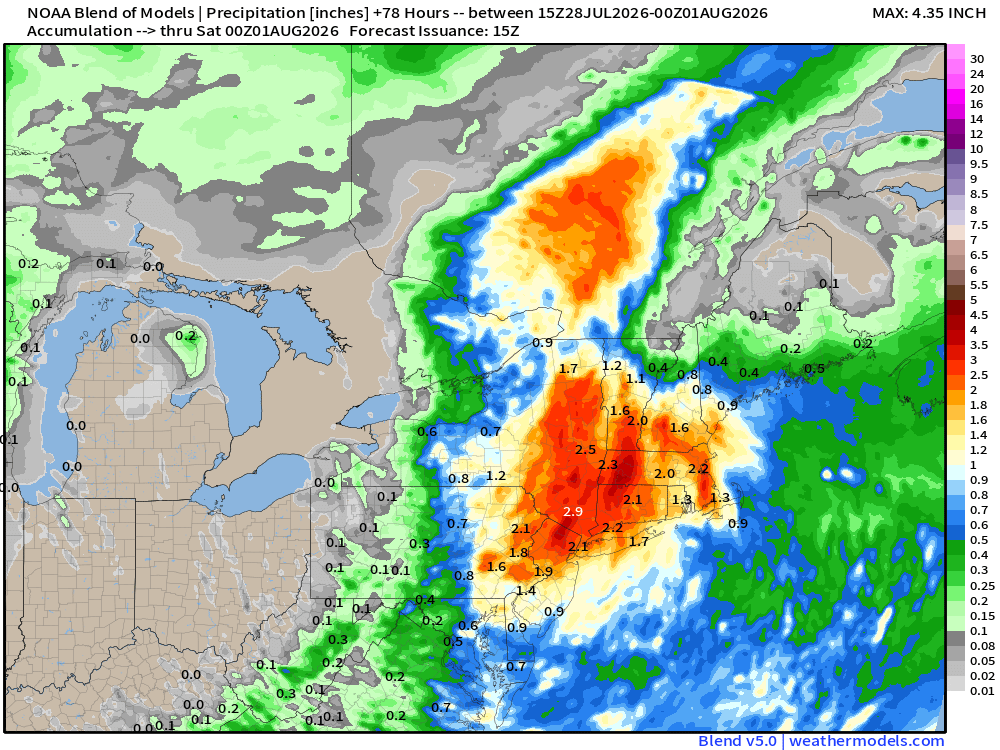
Once in place, this cut off low will remain through Friday the 31st, bringing rainfall totals between 2 and 5 inches in New York and western New England, and 1 to 3 inches further east. The movement of the surface low could see this heavy rain extend as far south as North Carolina, though the most certain area is focused around NYC and the surrounding states. Localized totals could potentially exceed 6 to 7 inches. The 29th will see most of the rainfall from this system as it sets up over the region, with follow up showers moving through eastern New England on Thursday and Friday.
Rainfall through the night of the 31st. Widespread 2-4 inches is likely, with potentially higher localized totals. Image provided by Weathermodels.com
As heavy rainfall progresses, storm drains could get overwhelmed as their capacity is exceeded. Underpasses and other low lying areas will be most suceptible to flooding as drains back up, and water levels could rise quickly. While most of this water will be standing water, it only takes a few inches for a car to become stranded. The water also wont necessarily be clean water, as ground debris is picked up by rainwater flowing into the now flooded area.
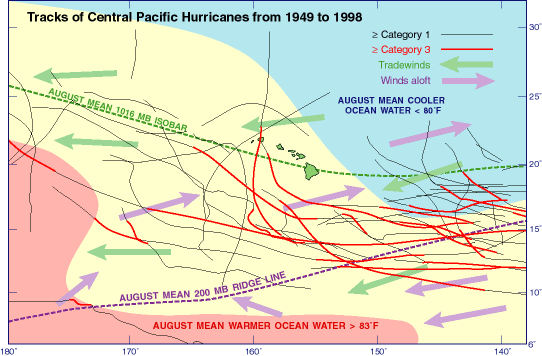
It should be no surprise that Hawaii receives the highest average annual rainfall of all the states in the US, given that it’s a set of islands in the middle of the Pacific Ocean.
Tracks of hurricanes that have passed near Hawaii from 1949 to 1998. Image provided by the USGS
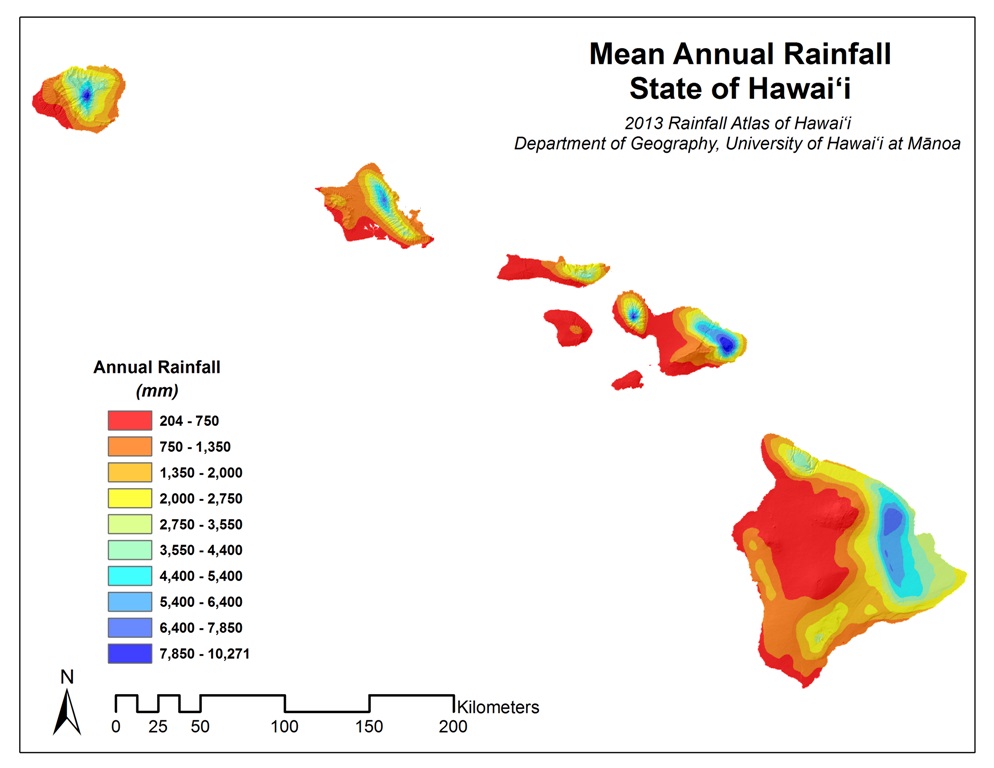
Of the islands, the “rainiest” island is debated to be between Maui and Kaua’i, with O’ahu, Hawaii (Big Island), Moloka’i, and Lana’i following in subsequent totals. Between 1912 and 1942, Mount Waiʻaleʻale on Kaua’i reported an average rainfall of 460 inches annually, and this is commonly quoted today. A more recent 30-year analysis estimates it to be around 360 inches of rain annually. Maui’s Big Bog, however, has a 30-year estimate of around 404 inches of rain, much higher than the 30-year analysis for Kaua’i.
Mean annual rainfall in Hawaii for 2013. Image provided by the University of Hawaii Department of Geography.
The geography of Hawaii creates an environment where the eastern side of each island gets most of the rainfall, while the western sides are more akin to desert-like climates; although they are islands, each is a volcanic mountain that rises much taller than one would expect. Mauna Kea on Hawaii (Big Island) has a peak of 13,803 feet tall. For comparison, Mount Elbert, the tallest US peak in the Rocky Mountains, stands at 14,440 feet when measured from sea level. This places Mauna Kea well within the upper ranges of mountain peaks if it were placed in the Rocky Mountains. However, when measured from its base, Mauna Kea is the tallest mountain in the world, whereas Mount Everest is the highest peak elevation.
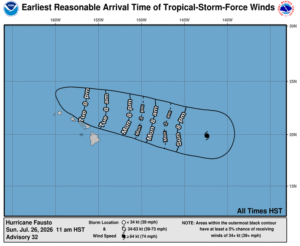
Being in the middle of the Pacific Ocean also has an effect, of course. It is often grazed by hurricanes or their remnants, though most do not make direct impacts. Most storms track south of Hawaii where equatorial Pacific waters are warmest, with outer bands or remnant storms having the most impact, placing them well outside of the normal forecast cone. Hurricane Fausto is an anomaly in this sense, as its forecast cone has it directly impacting Hawaii as a Tropical Storm. It is still too soon to determine how strong the wind and rain from Fausto will be once it reaches the islands; however, these should start to resolve as Fausto approaches the islands.
Estimated arrival of tropical storm-force winds from Fausto for the Hawaiian Islands. Image provided by the NHC/NOAA
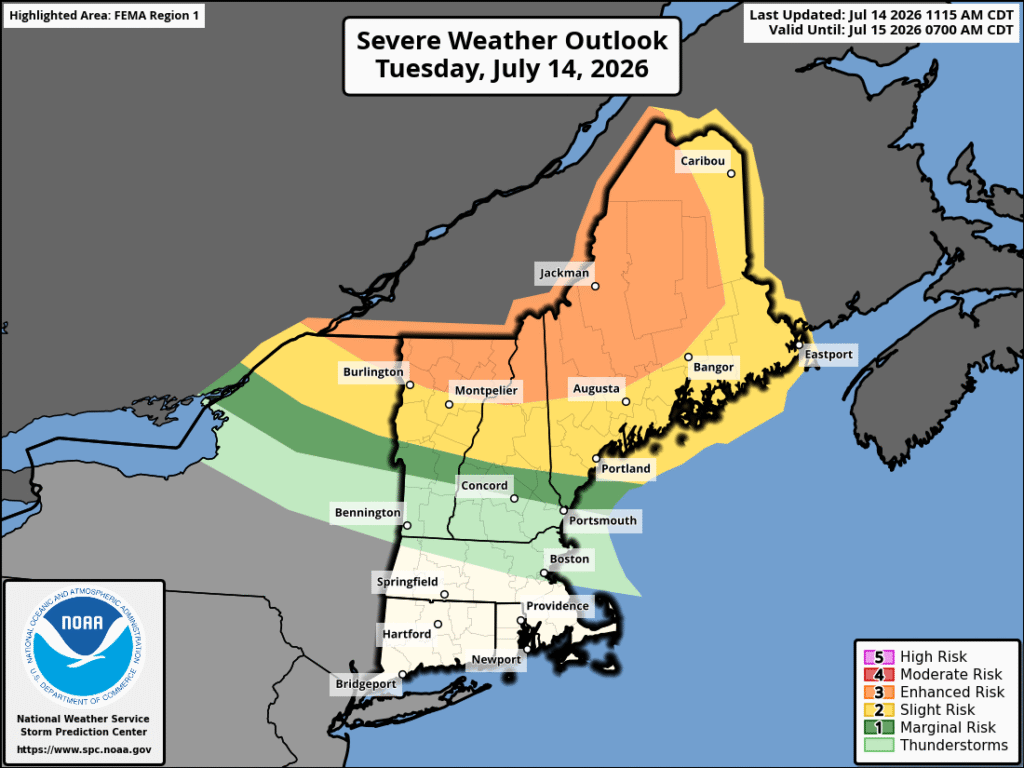
Severe weather doesn’t often make its way to the Northeast to the level that other regions of the country see. When it does, however, it generally comes from one of two directions, from the south along the coast, or from the northwest in southern Canada. The severe weather moving through today and tonight of July is one case of weather coming from the northwest.
Severe Weather potential for the Northeast on July 14th, bringing a risk of tornadoes, wind, and hail to the region. Image provided by NOAA
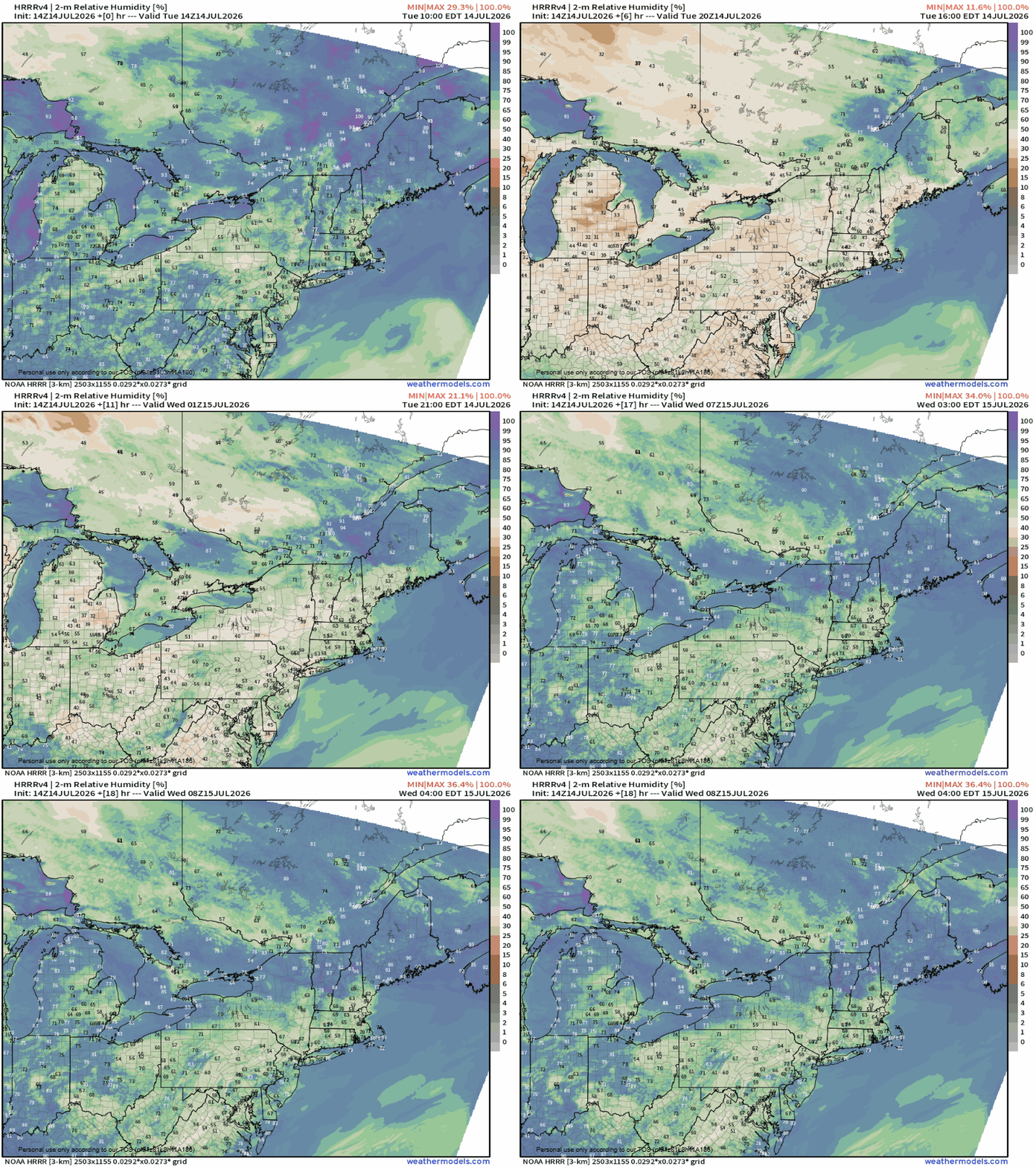
Weather from the northwest is generally hindered by a lack of humidity, as the further northward you move, the less available moisture there is. The less moisture, the less available total energy there is for storms to form, whereas weather from along the coast generally is limited by the ocean as systems leave New Jersey and pass over both the ocean and Long Island before impacting parts of New England.
Relative humidity from Tuesday the 14th to Wednesday the 15th. Loop provided by Weathermodels.com
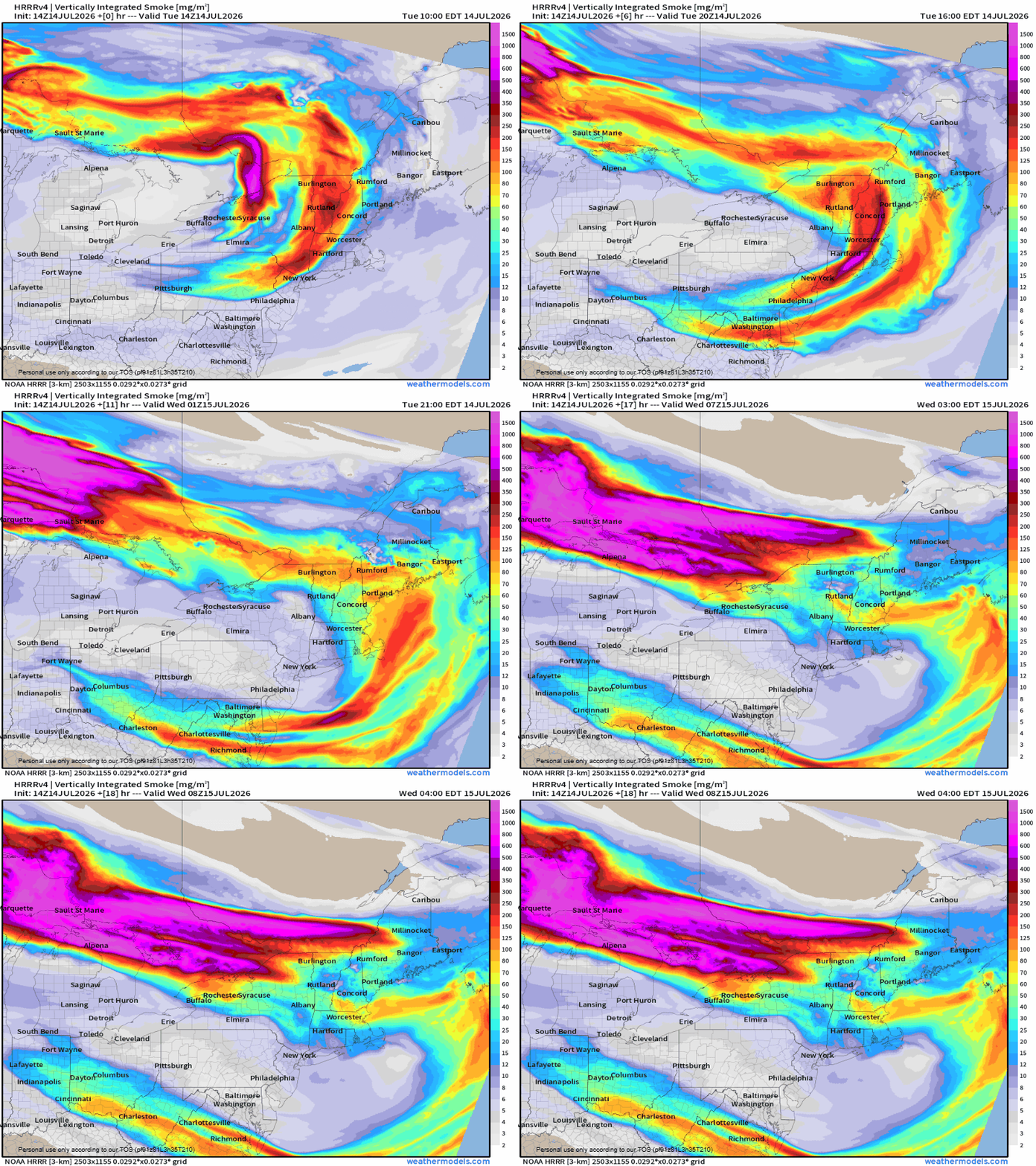
Wildfires also play a part in this, as the smoke from them gets high into the atmosphere, injecting drier air, but they can also promote storm formation if particulate that is released by them manages to mix with more moist air. Wildfires in Ontario are the source of the smoke for the next few days.
Canadian wildfires lifting dry air and smoke and dry air into the atmosphere, hindering ground heating needed to form significant storms. Loop provided by Weathermodels.com
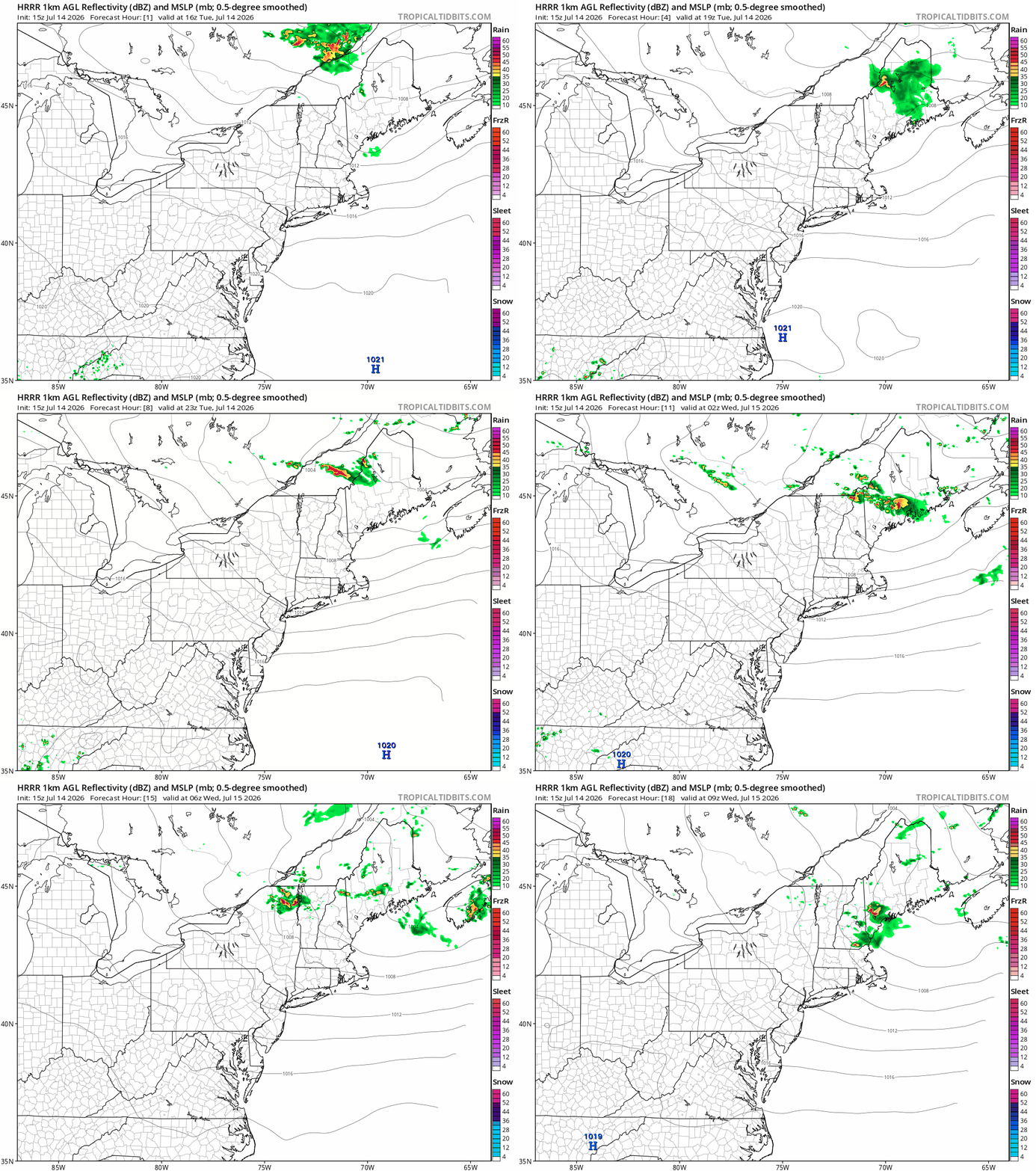
For the current storms moving through, wind, hail, and tornadoes are all expected to be on the stronger side when they occur. Most of the severe threat is limited to areas that are generally less populated in northern Vermont, New Hampshire and Maine, though this does not mean that severe weather won’t move into more populated regions, and a system could move through southern New Hampshire overnight on the 14th into the 15th, bringing showers and strong winds, with the potential for hail and tornadoes as the night progresses.
Storms moving through New England on the 14th overnight in to the 15th. Loop provided by Tropical Tidbits
Cooler and drier air will move into New England on July 15 behind a cold front.
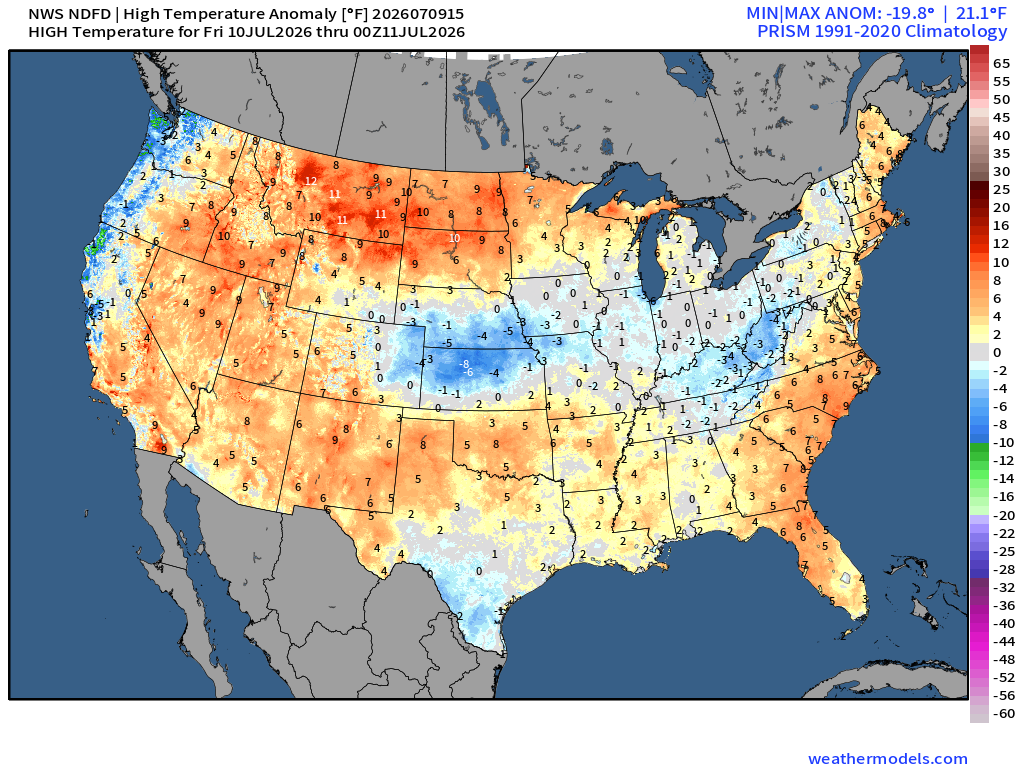
The weekend of the 10th will bring excessive rain and flooding to the Ohio Valley, Heat to the Midwest and Southwest, and near-average conditions for the Northeast.
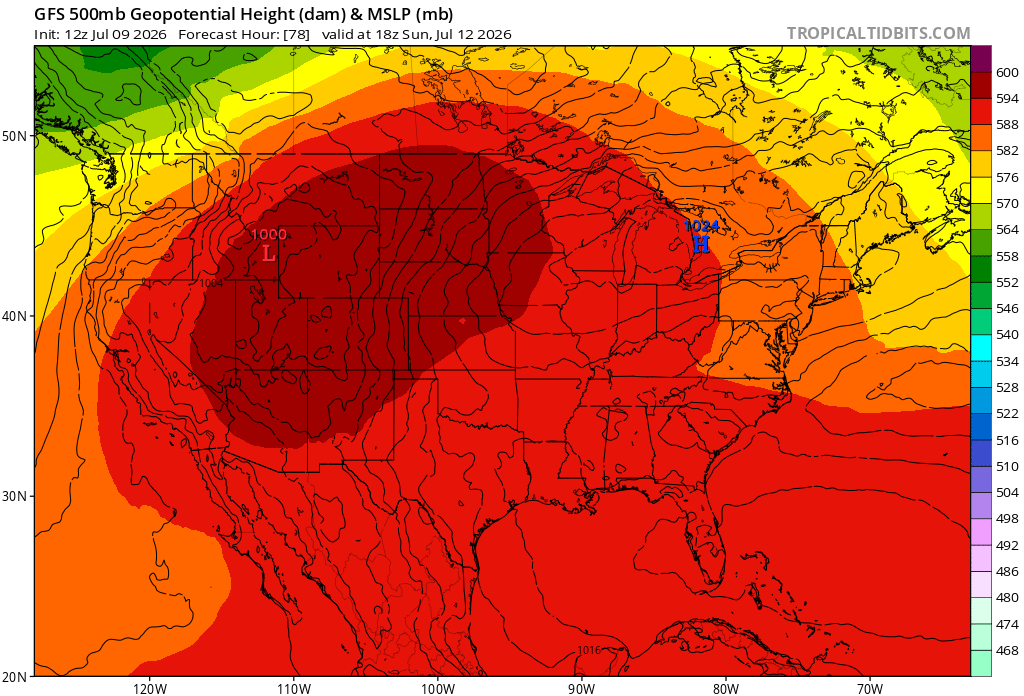
An upper level ridge will move into the northwestern US, bringing high temperatures in the 100s to the northern Rockies. Image provided by Tropical Tidbits
For Friday, highs across the country will be in the 80s and 90s, with lows in the high 40s to low 60s across the northern US and the eastern Rockies, while the southern and central US will see 70s into the low 80s. Much of the country will be near normal for this time of year. Central Kansas will be on the cooler side, around 8 degrees below normal as a surface front moves southward, while the Northern Rockies will be 10 degrees above average for both high and low temperatures. Light showers can be expected across the eastern US, with the southern Ohio Valley seeing localized amounts of 1 to 2 inches of rain. The southwestern and western US also face an elevated risk of fire as moisture moves out of the region.
High temperatures for most of the country will be within 5 degrees of normal, though the Northern rockies and the Central Plains stand out as above and below respectively. Image provided by WeatherModels.com
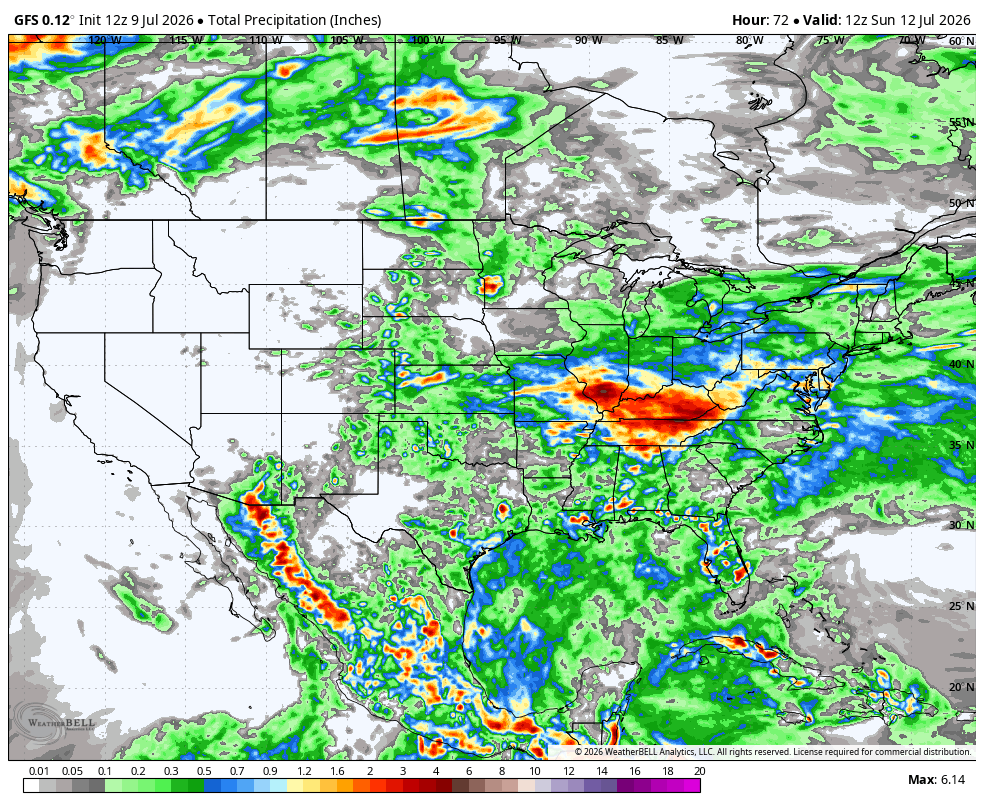
For Saturday, much of the southern and western US could see high temperatures in the high 90s to above 100 degrees as an upper level high settles over the region. The Northern Rockies are notably warm, with temperatures almost 20 degrees above average across Montana and North Dakota. Saturday will see continued rainfall in the southern Ohio Valley into the Mid-Atlantic as the front moves southward, with scattered showers continuing through the weekend. Southern Indiana and Tennessee could see localized totals between 2 and 4 inches, causing flash flooding, with 2-day totals reaching up to 6 inches.
Rainfall totals across the eastern US will be less than an inch, with the Southern Ohio Valley and northwestern Mid-Atlantic receiving 3 to 6 inches of rain. Image provided by WeatherBell
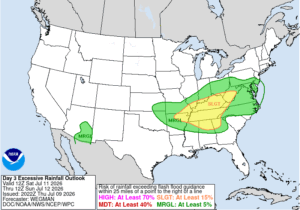
In the Northern Rockies, where temperatures are well above average, extreme heat warnings are in effect, and local daily records are likely to be set in many cities. Outdoor activities are recommended to be minimized where possible, and plenty of water and breaks are recommended where not. In the southern Ohio Valley and northwestern Mid-Atlantic, a slight risk of excessive rainfall persists with storms Friday and Saturday, when flash flooding is most likely.
Areas across the Tennessee and Ohio Valleys are at risk of flooding as a result of excessive rainfall. Image provided by the Weather Prediction Center.
On Sunday, highs in the northeast will remain in the 80s and 90s in the southeast. The Southwest and the Rockies will remain 10-15 degrees above normal, with highs in the upper 90s to above 100 degrees from southern California to Montana and the Dakotas. Up to 1 inch of rain is expected as the storms move deeper into the Mid-Atlantic, with Eastern Kentucky, Western Virginia, and the Carolinas potentially seeing localized rainfall of up to 3 inches. Most of the southern US will also see light showers through the day.
While the United States was celebrating its 250th birthday on the 4th, the Northern Mariana Islands were ravaged by Super Typhoon Bavi, which crossed the tiny island of Rota with the strength of a Category 5 hurricane on July 5th.
While storms of this strength might be devastating for the United States and parts of the Caribbean, areas in the Western Pacific, including the Northern Mariana Islands, and countries such as Japan, Taiwan, and China have had the time to build up infrastructure and procedures to mitigate the impacts of these storms.
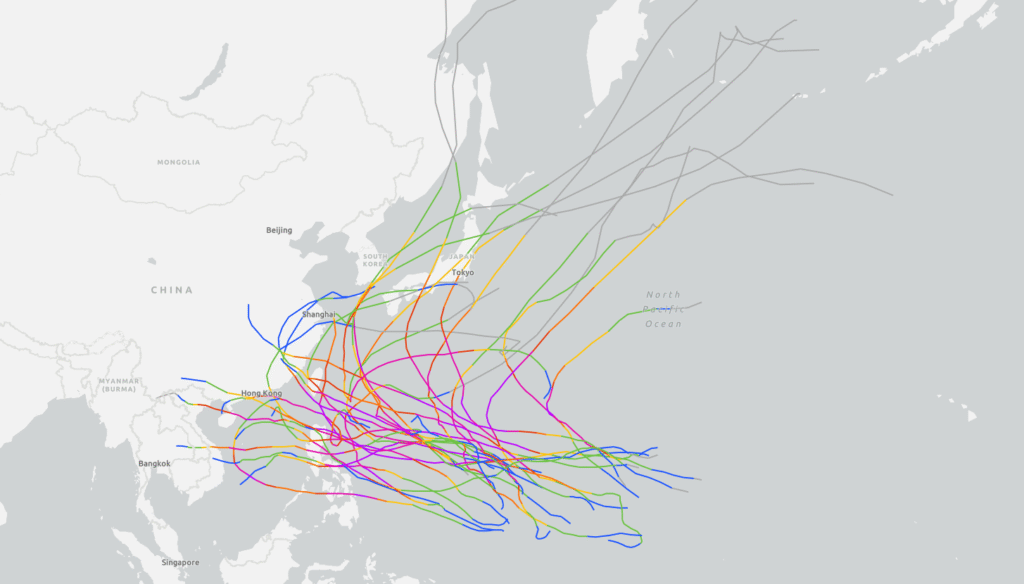
Map of the 30 most recent (satellite estimated at any point) Category 5 equivalent Super Typhoons in the Western Pacific. Many storms in the Pacific may approach land, but most remain at sea. Image provided by NOAA.
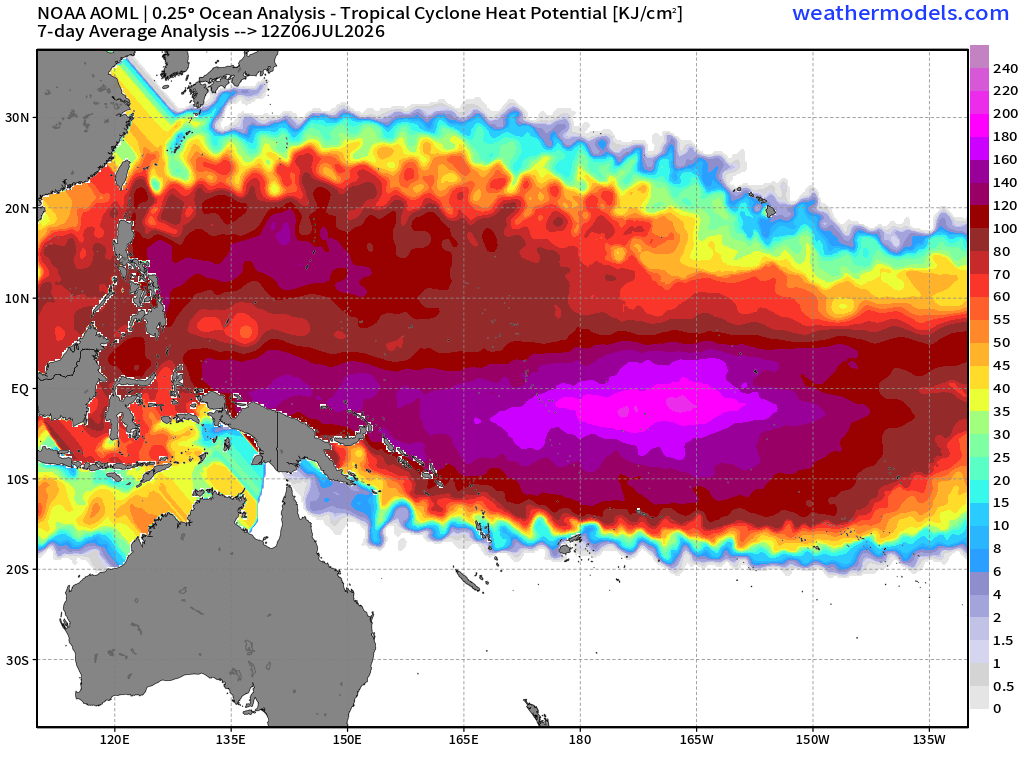
By far the biggest difference in the Western Pacific tropical season and the Atlantic tropical season is the length of the season. While the Atlantic season officially runs from June 1st to November 30th, the Western Pacific “season” runs all year, however the frequency of storms in the summer is larger compared to the winter. With a stronger El Nino, such as this year, the region for storm formation extends much further east than it does normally. Any storms that form in this extended region are likely to become Category 4 or 5 equivalent if other conditions are favorable, as they will have even more time over very warm water.
Tropical Cyclone heat potential is currently shifted east into the Central Pacific due to El Nino, allowing storms to form further into the Pacific than they normally would. Image provided by Weathermodels.com
This is also not the first Super Typhoon to have affected the Northern Marianna Islands this year. Super Typhoon Sinlaku impacted the Mariana Islands in April 2026, passing directly over Saipan, and while it did bring significant damage to the region, the most significant effect of Sinlaku was the damage to the power grid, and to buildings such as sheds or other outbuildings, as well as minor damage to the roofs of some commercial buildings. Despite the collapse of the power grid in the Northern Mariana Islands, power was restored to a majority of the island in just 3 days.
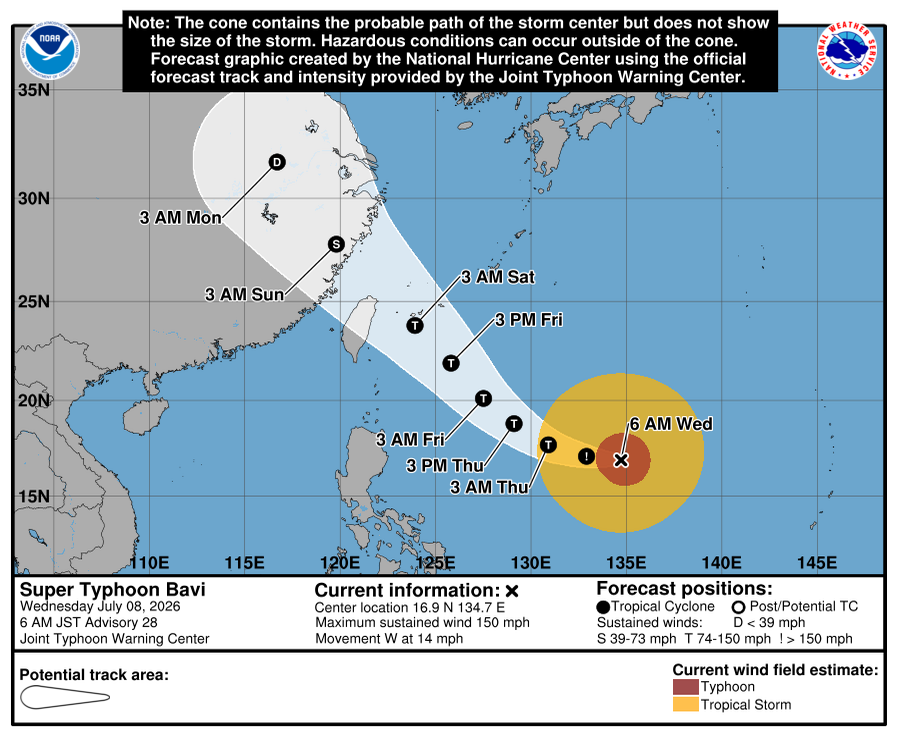
The island of Rota was directly hit by the eye of Bavi, causing widespread damage to the island. The National Weather Service expects all trees and powerlines to be snapped, causing the island to be potentially uninhabitable for weeks as recovery efforts get underway. The airport on the island was approved for emergency use, improving recovery efforts through the island. Super Typhoon Bavi remains as Category 4 equivalent storm into the Philippine sea, and is expected to impact Taiwan by early Saturday and eastern China early on Sunday local time.
Super Typhoon Bavi will be an increasing threat to Taiwan and eastern China later this week. Image provided by the National Weather Service office in Tiyan, Guam.
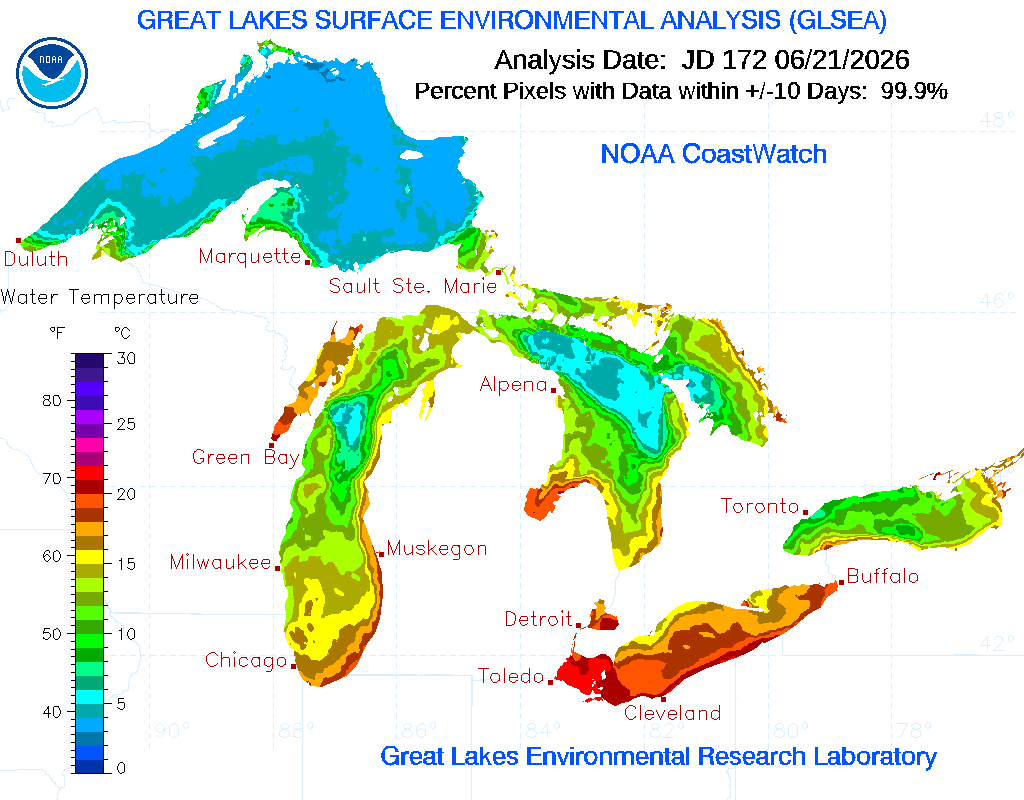
Halfway through June, and the Great Lakes surface temperatures range from average to well below average. From Lake Erie being the shallowest, and Lake Superior being the largest, they play a large part in controlling the climate of downwind regions.
Lake superior is well below average temperature for this time of year, while other lakes are sitting just below average or right around it. Image provided by NOAA
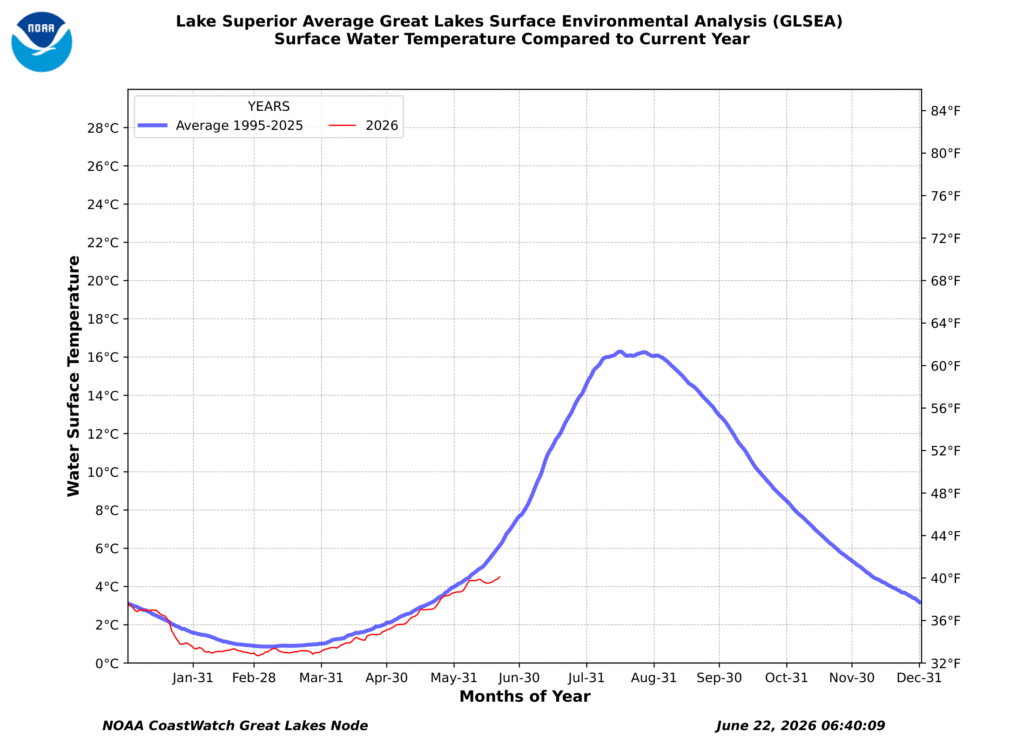
Befitting of its name, Lake Superior is the largest of the Great Lakes. Acting as a barrier between northerly winds and the Upper Peninsula of Michigan, Lake Superior helps keeps temperatures cool and assists in stabilizing the weather, though if conditions are setup just right, it can bring heavy lake effect snow to those same locations. In June, Lake Superior’s surface temperatures are below average, resting below 40 degrees across the lake. At this time of year, Lake Superior is typically in the lower to mid 40s.
Lake Superior average temperatures at this time of year range in the low to mid 40s. Graph provided by NOAA
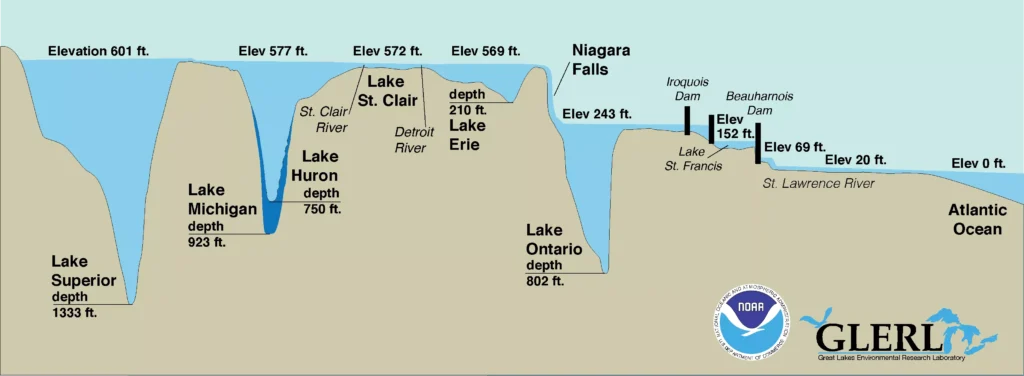
Lake Superior is the deepest of the great lakes sitting at an average of 483 feet. Its deepest point sits 1332 feet below its surface, deep enough to submerge the Empire State building, not including its spire. But not all of the great lakes are this deep. Lake Erie holds the title as the shallowest of the Great Lakes, sitting at a mere 62 feet deep on average. Its deepest point rests at 210 feet.
The Great Lakes vary greatly in depth, with Lake Superior sitting at 1332 feet at its deepest, and Lake Erie at 210 feet at its deepest. Image provided by NOAA
In relation to its low average depth, Lake Erie has the warmest temperature on average, as its thermal reservoir of water is much shallower than that of the other great lakes. Lake Erie is currently sitting at mid to high 60s, which is right on average temperature for where it should be for mid June. It also cools the quickest, allowing ice to form on it earlier than any other lake.
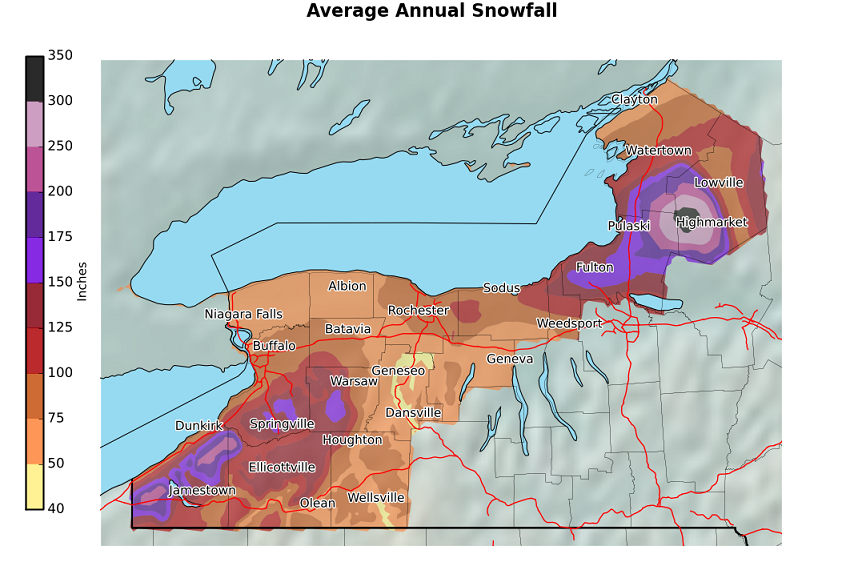
Lake Ontario Produces the most lake effect snow of the Great Lakes, though Lake Erie and Buffalo, NY typically make the news more. In the winter of 2025-26, Lake Ontario produced nearly 27 feet of snow near Worth, NY in the Tug Hill region. Lake Effect Snow is created when cold, dry air moves over the still warm waters of the great lakes. Warm, moist air then quickly rises and condenses, falling as snow once the source of heat has left, most commonly over the opposite shore from the wind.
Annual Snowfall Averages for the southern Great Lakes region in New York, highlighting how Lake Ontario creates more lake effect snow than Lake Erie. Image provided by the Buffalo, NY forecast office
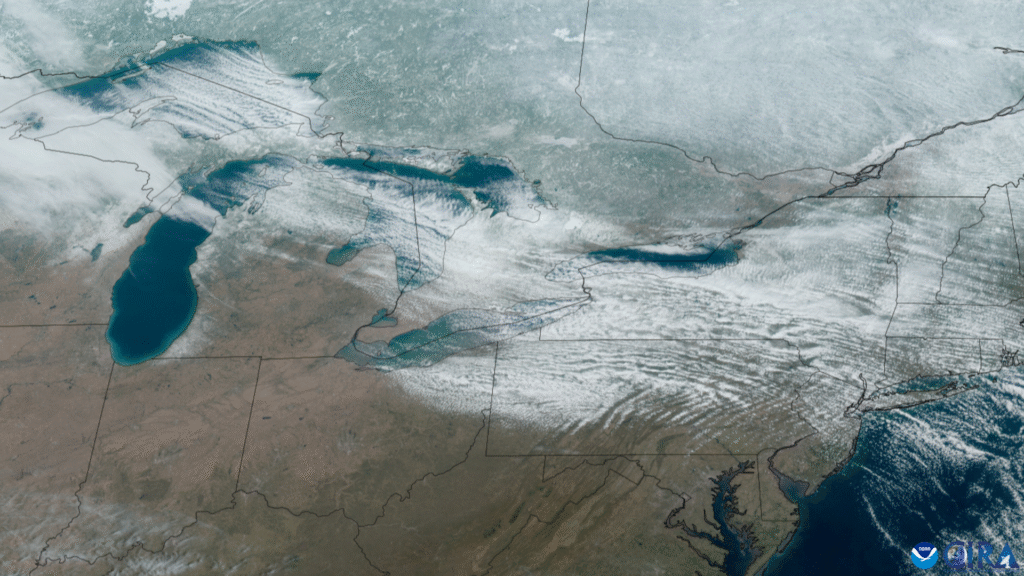
Lake Huron, While not being the largest of the Great Lakes, holds the title of longest shoreline, accredited in part to the more than 30,000 islands that it hosts, most of which are in the Georgian Bay or in Ontario, Canada. When conditions are just right, Lake Huron helps to fuel immensely long snow bands, increasing the snow from both lake Erie and Lake Ontario.
Lake effect snow across the Great Lakes region, showing how the subsequent lakes can reinforce downstream snow. Image provided by CSU/CIRA and NOAA.
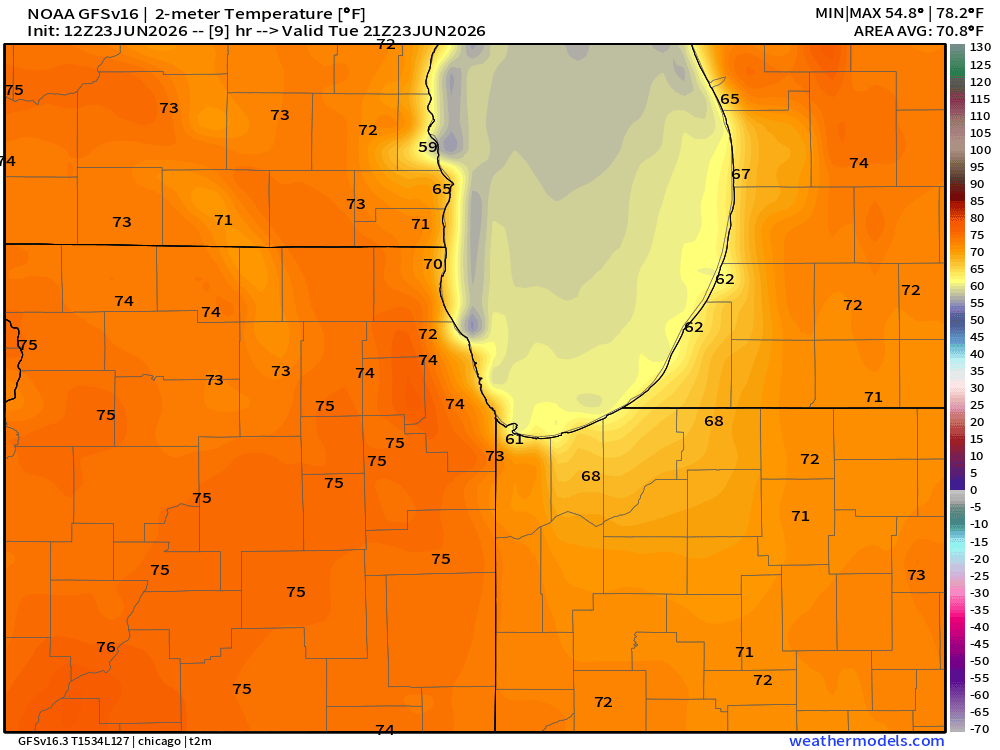
Finally, Lake Michigan is generally the most well known of the Great Lakes. All of the Great Lakes also produce lake breezes, where wind flows from the Lakes onto land, cooling shorelines significantly. They occur when land and air temperatures are much warmer than water temperatures, and there is little wind to slow development. Lake breezes cool coastlines between 10 and 20 degrees, reaching 30 degrees if they are strong enough.
Lake breeze around the southern half of Lake Michigan. The strongest cooling is seen in Wisconsin, at 59 degrees in Milwaukee. Image provided by Weathermodels.com
The Great Lakes are both a cultural corner stone and a significant weather component in North America. They provide cooling effects in the summer and heating effects in the winter, creating a more temperate climate surrounding them, as well as allowing for easy transport of goods across the region.