It should be no surprise that Hawaii receives the highest average annual rainfall of all the states in the US, given that it’s a set of islands in the middle of the Pacific Ocean.
Of the islands, the “rainiest” island is debated to be between Maui and Kaua’i, with O’ahu, Hawaii (Big Island), Moloka’i, and Lana’i following in subsequent totals. Between 1912 and 1942, Mount Waiʻaleʻale on Kaua’i reported an average rainfall of 460 inches annually, and this is commonly quoted today. A more recent 30-year analysis estimates it to be around 360 inches of rain annually. Maui’s Big Bog, however, has a 30-year estimate of around 404 inches of rain, much higher than the 30-year analysis for Kaua’i.
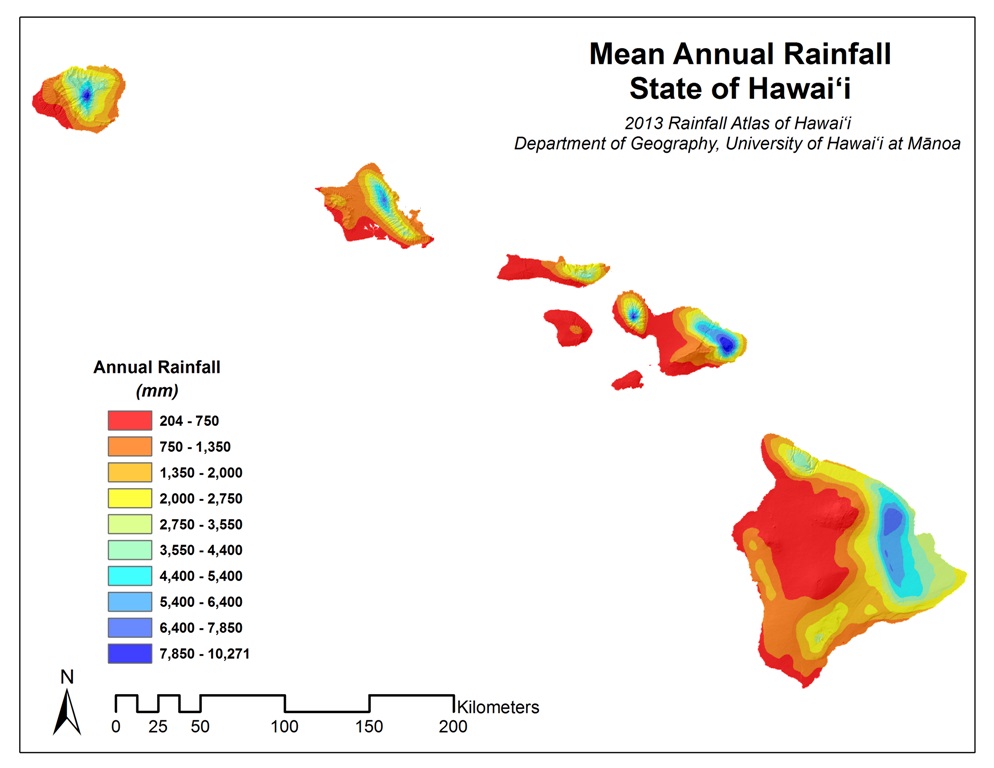
The geography of Hawaii creates an environment where the eastern side of each island gets most of the rainfall, while the western sides are more akin to desert-like climates; although they are islands, each is a volcanic mountain that rises much taller than one would expect. Mauna Kea on Hawaii (Big Island) has a peak of 13,803 feet tall. For comparison, Mount Elbert, the tallest US peak in the Rocky Mountains, stands at 14,440 feet when measured from sea level. This places Mauna Kea well within the upper ranges of mountain peaks if it were placed in the Rocky Mountains. However, when measured from its base, Mauna Kea is the tallest mountain in the world, whereas Mount Everest is the highest peak elevation.
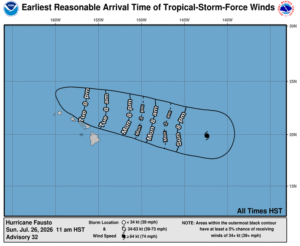
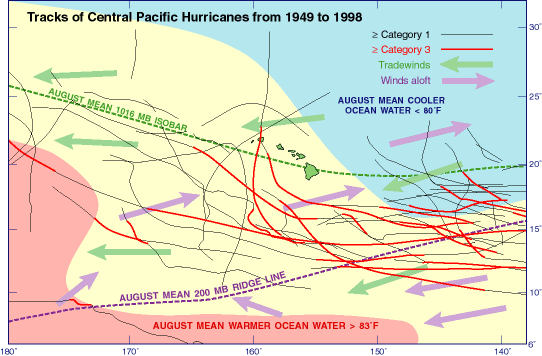
Being in the middle of the Pacific Ocean also has an effect, of course. It is often grazed by hurricanes or their remnants, though most do not make direct impacts. Most storms track south of Hawaii where equatorial Pacific waters are warmest, with outer bands or remnant storms having the most impact, placing them well outside of the normal forecast cone. Hurricane Fausto is an anomaly in this sense, as its forecast cone has it directly impacting Hawaii as a Tropical Storm. It is still too soon to determine how strong the wind and rain from Fausto will be once it reaches the islands; however, these should start to resolve as Fausto approaches the islands.